
Must Do in Crete: The Complete 2026 Guide to the Best Things to Do and See
If you only have time for a handful of stops, the must do in Crete list comes down to five things: hike the Samaria Gorge, see the turquoise water at Balos Lagoon, wander the old town in Chania, walk through Knossos Palace, and eat your way through a Cretan taverna menu. Crete is the largest island in Greece, and it packs mountains, ancient ruins, and some of the best beaches in Europe into one coastline. That size is exactly why most first-time visitors feel overwhelmed trying to plan around it.
The confusion usually starts with a simple question. Is three days enough? Is Balos really better than Elafonisi? Do you need a car, or is that just an upsell from rental sites? This guide answers those questions directly, the way a local travel planner would over coffee in Chania’s old harbor.
What is Crete best known for?
Crete is best known for being the birthplace of the Minoan civilization, Europe’s oldest known advanced culture, centered around the ruins of Knossos Palace just outside Heraklion. Beyond ancient history, the island is famous for its beaches, particularly the pink sand at Elafonisi and the glowing lagoon at Balos, along with the Venetian old towns of Chania and Rethymno and a food culture built around olive oil, wild greens, and slow-cooked lamb.
Locals often describe Crete as a country within a country. It has its own dialect quirks, its own version of the Mediterranean diet, and a mountain culture in villages like Anogeia that feels worlds away from the beach resorts on the coast. That contrast, wild interior against polished coastline, is a big part of why travelers who plan around one region miss half of what makes the island special.
How many days do you need to see the must-dos in Crete?
Three days is enough to see one region properly, usually Chania plus a nearby beach and a Knossos day trip if you’re based near Heraklion instead. A full week lets you add the Samaria Gorge hike and the south coast without feeling rushed. Two weeks covers the entire island, including Agios Nikolaos and Spinalonga Island in the east.
Here is how that breaks down in practice.
[Itinerary Table]
| Trip Length | Regions Covered | Must-Do Highlights |
| 3 days | Chania or Heraklion base | Old town, one beach, Knossos or Samaria day trip |
| 5 to 7 days | West and central Crete | Chania, Rethymno, Samaria Gorge, Balos, Elafonisi |
| 10 to 14 days | Full island loop | All of the above plus Agios Nikolaos, Spinalonga, Vai Beach, Lassithi Plateau |
Travelers consistently find that trying to cover the whole island in under five days means spending more time driving than actually being somewhere, since some south coast roads wind through mountains at a slower pace than the map distance suggests.
What are the top things to do in Crete first-time visitors shouldn’t skip?
First-timers should prioritize Knossos Palace, the Samaria Gorge hike, Balos Lagoon, Elafonisi Beach, and simply wandering Chania’s old town and Venetian harbor at sunset. These five cover history, nature, beach, and culture without repeating the same kind of experience twice, which matters more than chasing a long checklist.
Is Knossos Palace worth visiting?
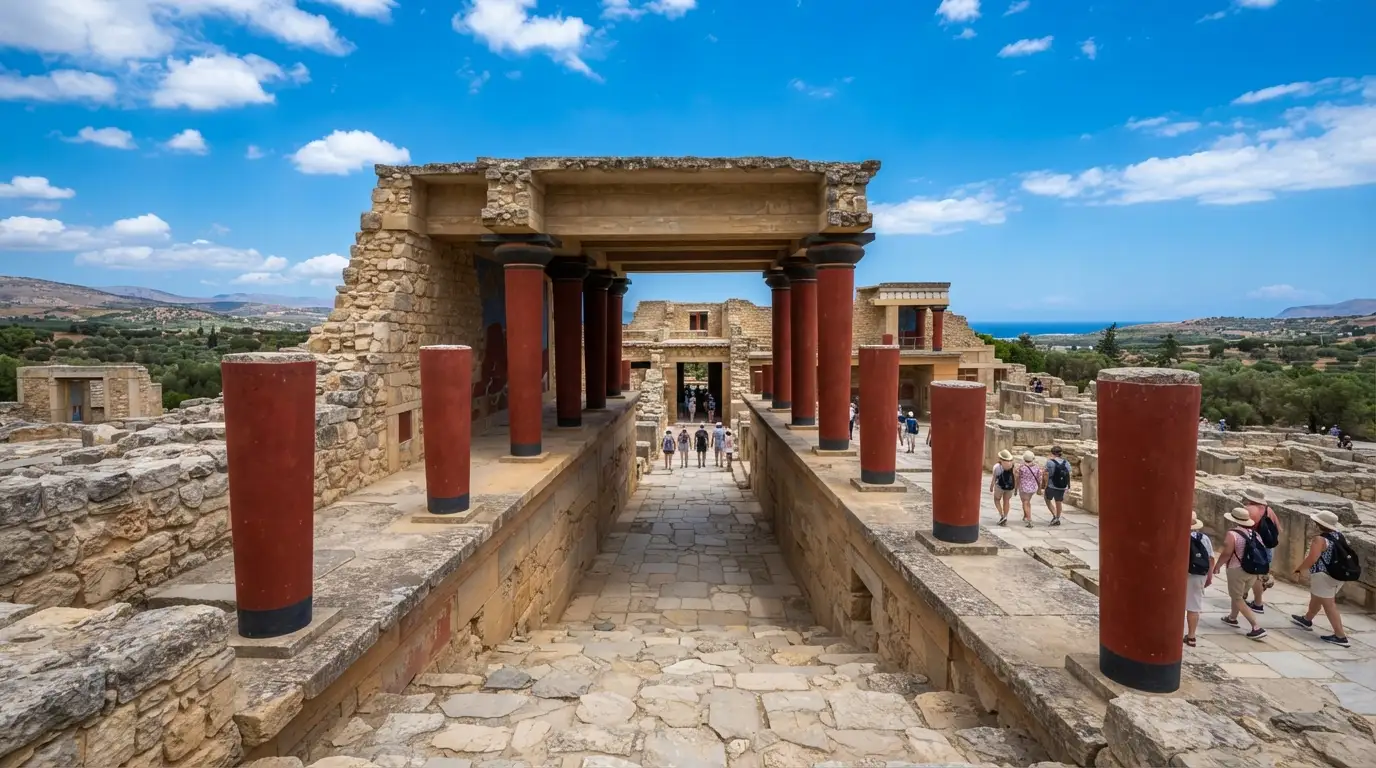
Knossos Palace is worth the visit, and it is genuinely one of the most important archaeological sites in Europe. The official entrance fee sits around 20 euros for a full ticket and 10 euros for reduced categories, with free entry for EU visitors under 25 and children under 18 from most countries, though it varies by nationality and season, so check current rules before you go. Expect to spend about two hours walking the site, longer if you add the audio guide or a small group tour.
A common mistake first-time visitors make is arriving around 10am, right when tour buses from Heraklion cruise ships and resorts start unloading. Arriving close to opening, around 8am in the warmer months, or visiting in the late afternoon instead, gives you a much quieter walk through the throne room and the reconstructed sections Sir Arthur Evans added in the early 1900s. Parking near the site fills quickly in July and August, so budget extra time if you’re driving yourself.
One honest downside worth mentioning: the Minoan ruins here are mostly low walls and foundations, not the full standing structures shown in postcards. That doesn’t make the site less important, but it does mean a guided tour or a bit of pre-reading adds far more value than walking through blind.
How hard is the Samaria Gorge hike?
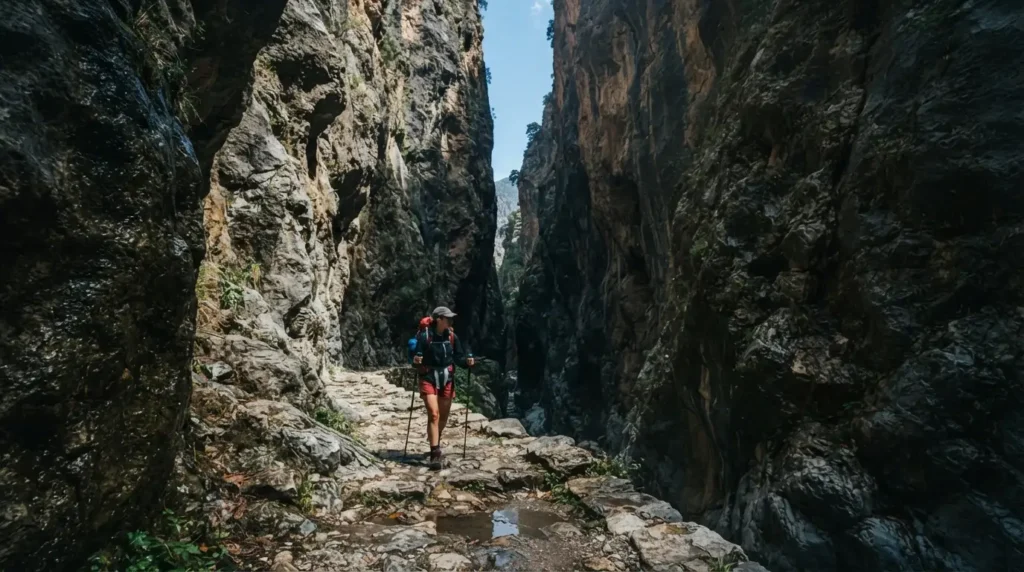
The Samaria Gorge hike is long but not technically difficult, roughly 16 kilometers one way through the White Mountains, usually taking five to seven hours depending on fitness and how many photo stops you make. The trail starts at Omalos, drops steeply for the first hour, then flattens out and follows a dry riverbed down to the coastal village of Agia Roumeli.
Because it’s a one-way hike, most visitors book an organized full-day tour from Chania or Rethymno that handles transport to the start and the return trip, which involves a scenic boat ride from Agia Roumeli to Chora Sfakia and a bus back. The gorge is typically open from early May through mid October, closing outside that window due to flood risk, so shoulder season travelers should confirm dates before building a trip around it.
Bring sturdy shoes, not sandals. The trail surface is loose rock in sections, and there are fresh water refill points along the route so a small bottle is usually enough rather than carrying gallons. The narrowest section, known as the Iron Gates, is where the canyon walls close in to just a few meters apart, and it’s the visual payoff most hikers remember.
Is Balos Beach or Elafonisi Beach better to visit?
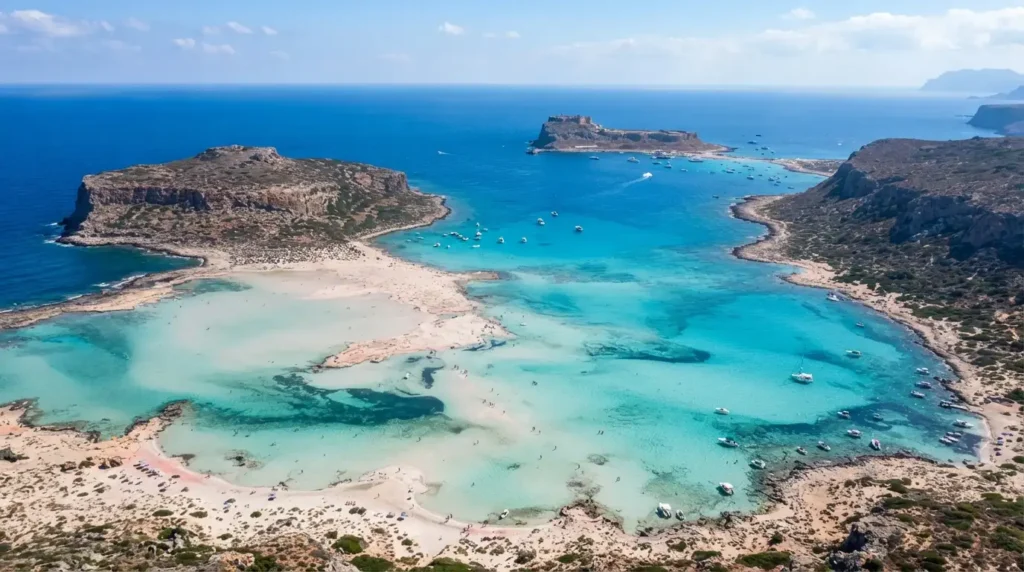
Balos Beach and Elafonisi Beach both make nearly every must do in Crete list, but they suit different travelers. Balos has a wilder, more dramatic lagoon with pink-tinged sand and a shallow bay that shifts color depending on the light, but getting there involves either a rough unpaved road or a boat tour, and the site can get windy. Elafonisi has calmer, shallower water crossing a sandbar to a small islet, easier parking, and a gentler feel that suits families and less mobile travelers better.
[Comparison Table]
| Feature | Balos Beach | Elafonisi Beach |
| Access | 4WD track or boat tour from Kissamos | Paved road, larger car park |
| Water | Shallow lagoon, can be windy | Calm, warm, shallow crossing |
| Sand color | White to pink | Pink to white |
| Best for | Photography, dramatic scenery | Families, easy relaxing day |
| Crowd level in August | High by boat, moderate by car | Very high midday |
A standard rental sedan will struggle on the unpaved section of the Balos access road, so travelers without a 4×4 usually find the boat tour from Kissamos, which also stops at Gramvousa Island, the more comfortable option. Whichever beach you pick, arriving before 10am or after 4pm in July and August avoids the worst of the midday crowds and heat.
What things to see in Crete cover its history and culture?
Beyond Knossos, Crete’s cultural must-sees include Phaistos, a quieter Minoan palace site near Matala with fewer crowds and clear signage, Malia Palace along the north coast, and Arkadi Monastery near Rethymno, tied to a significant moment in Crete’s fight for independence in 1866. The Heraklion Archaeological Museum houses the artifacts actually found at these sites, including the famous Phaistos Disc, and pairs naturally with a Knossos visit on the same day.
Rethymno and Chania both deserve a slow half-day of just walking rather than checking off individual sights. Rethymno’s old town is built from honey-colored stone rather than the whitewash seen elsewhere in Greece, with narrow lanes leading to a Venetian fortress worth visiting at sunset. Chania’s old town centers on its Venetian harbor and lighthouse, with a food scene strong enough that locals recommend building an entire evening around dinner there, trying dakos, a barley rusk topped with tomato and mizithra cheese, or boureki, a Chania specialty layering potato, zucchini, and cheese.
Where to stay in Crete for the best access to must-do sites?
Chania suits travelers focused on beaches, the Samaria Gorge, and west coast day trips like Balos and Elafonisi. Heraklion works better for travelers prioritizing Knossos, the Archaeological Museum, and flights or ferries, since it’s the island’s main transport hub. Agios Nikolaos suits those wanting Spinalonga Island and a quieter, less crowded east coast base.
Most visitors find that splitting a longer trip across two or three bases, rather than one hotel for the whole stay, cuts down significantly on daily driving time. A common pattern for a one-week trip is two or three nights in Chania, followed by two or three nights around Rethymno or the south coast near Plakias.
What are the best places to visit in Crete for beaches beyond Balos and Elafonisi?
Vai Beach on the east coast sits inside Europe’s only natural palm forest, giving it a genuinely tropical look that stands apart from every other beach on the island, though it’s a longer drive from the main west coast bases. Falassarna Beach, close to Chania, offers wide open sand and strong sunsets without needing a boat trip. Preveli Beach combines a palm-lined river mouth with a proper swimming beach, reached by a steep set of steps or a boat from Plakias. Matala Beach, with its ancient carved cliff caves once used as tombs and later homes, adds a bit of offbeat history to a beach day, and pairs naturally with a short hike to Red Beach next door.
Is Vai Beach worth the drive?
Vai Beach is worth the drive for travelers who want a landscape unlike anywhere else in Crete, but it sits far to the east near Sitia, roughly a full day trip from Chania or Rethymno. Travelers based in Agios Nikolaos or planning an east coast loop get far more value from it than those based on the west coast trying to fit it into a single day.
What activities in Crete work well for a road trip itinerary?
A Crete road trip typically flows from Heraklion, where most flights and ferries arrive, east to Agios Nikolaos for Spinalonga Island, back through the center or south coast toward Plakias for beach time, then to Rethymno for the old town and a Samaria Gorge day, finishing in Chania to close out the trip near the airport or ferry port.
- Heraklion: 2 nights, Knossos and the Archaeological Museum
- Agios Nikolaos: 2 nights, Spinalonga Island and Lake Voulismeni
- Plakias or Matala: 1 to 2 nights, south coast beaches
- Rethymno: 2 to 3 nights, old town and Samaria Gorge
- Chania: 3 to 4 nights, Balos, Elafonisi, and old town dining
This loop avoids backtracking over the same roads twice, which matters more in Crete than it sounds, since mountain routes between the north and south coasts can take much longer than the straight-line distance suggests.
What things to do in Crete are possible without a rental car?
Travelers without a car can still reach nearly every major must-do. Samaria Gorge, Balos Lagoon, Spinalonga Island, and Knossos Palace all run as organized day tours from Chania, Rethymno, or Heraklion, typically including hotel pickup. Local buses, known as KTEL, also connect the main towns along the north coast reasonably well, though south coast village connections run less frequently, especially outside peak season.
Booking platforms like GetYourGuide and Viator list most of these tours, and prices generally run higher than doing it independently with a rental car, but they remove the stress of driving unfamiliar mountain roads, particularly the narrow switchbacks down to places like Balos or Imbros Gorge.
What are common mistakes or tourist traps to avoid in Crete?
The most common mistake is visiting Balos or Elafonisi in the middle of a July or August day, when both the heat and the crowds peak simultaneously, tour buses and cruise excursions converge, and parking lots at Elafonisi in particular fill by mid-morning. Another frequent misstep is underestimating driving times between south coast towns, where a route that looks like 40 kilometers on a map can take well over an hour on narrow mountain roads.
A less obvious trap is booking a rental car without checking whether the roads on your itinerary require a 4×4, since standard sedans struggle on the Balos access track and several gorge drive routes. Locals recommend checking road conditions and confirming with the rental company directly if Balos or a similar unpaved stretch is on the plan. Finally, skipping travel insurance is a mistake that rarely feels urgent until a missed ferry connection or a twisted ankle on the Samaria Gorge trail turns into an expensive problem.
Conclusion
The must do in Crete list doesn’t have to feel overwhelming once it’s broken into regions instead of one long scroll of beaches. Anchor a trip around Knossos Palace, the Samaria Gorge, and one standout beach like Balos or Elafonisi, then build the rest of the itinerary around whichever coast matches your pace, west for hiking and beach drama, east for quieter history and Spinalonga Island. Book Samaria Gorge and Knossos tickets ahead in peak summer, confirm road conditions before renting a standard car, and leave room in the schedule for the parts of Crete that never make anyone’s checklist, a quiet taverna dinner in Chania’s old town, a slow wander through a mountain village, or an unplanned swim at a beach that wasn’t on the list at all.
FAQs
What is the best month to visit Crete?
May, June, and September offer warm weather, open hiking trails including Samaria Gorge, and noticeably smaller crowds than July and August.
Is Crete worth visiting?
Yes. Few Greek islands combine ancient history, mountain hiking, and beach variety as completely as Crete does in one destination.
Do I need a car in Crete?
Not strictly, since tours and buses cover the main sites, but a car gives far more flexibility for reaching quieter beaches and villages on your own schedule.
Is Balos Beach or Elafonisi Beach better?
Balos suits travelers chasing dramatic lagoon scenery, while Elafonisi suits families and those wanting calmer, easier access water.
How hard is the Samaria Gorge hike?
It’s a long but manageable one-way trail, about 16 kilometers, best suited to hikers with average fitness and sturdy shoes.
Can you do Samaria Gorge without a guide?
Yes, independent hiking is common, though most visitors still book transport for the return trip from Agia Roumeli since it’s a one-way route.
Is a 4×4 needed for Balos Beach road?
For the unpaved access track, yes, a standard sedan will struggle, which is why many travelers choose the boat tour from Kissamos instead.
What is the best side of Crete to stay on, east or west?
West Crete, around Chania and Rethymno, suits travelers prioritizing beaches and the Samaria Gorge, while east Crete around Agios Nikolaos suits those wanting Spinalonga Island and a quieter pace.


