
How to Get Rid of Water Bugs: Identification, Treatment and Prevention (2026)
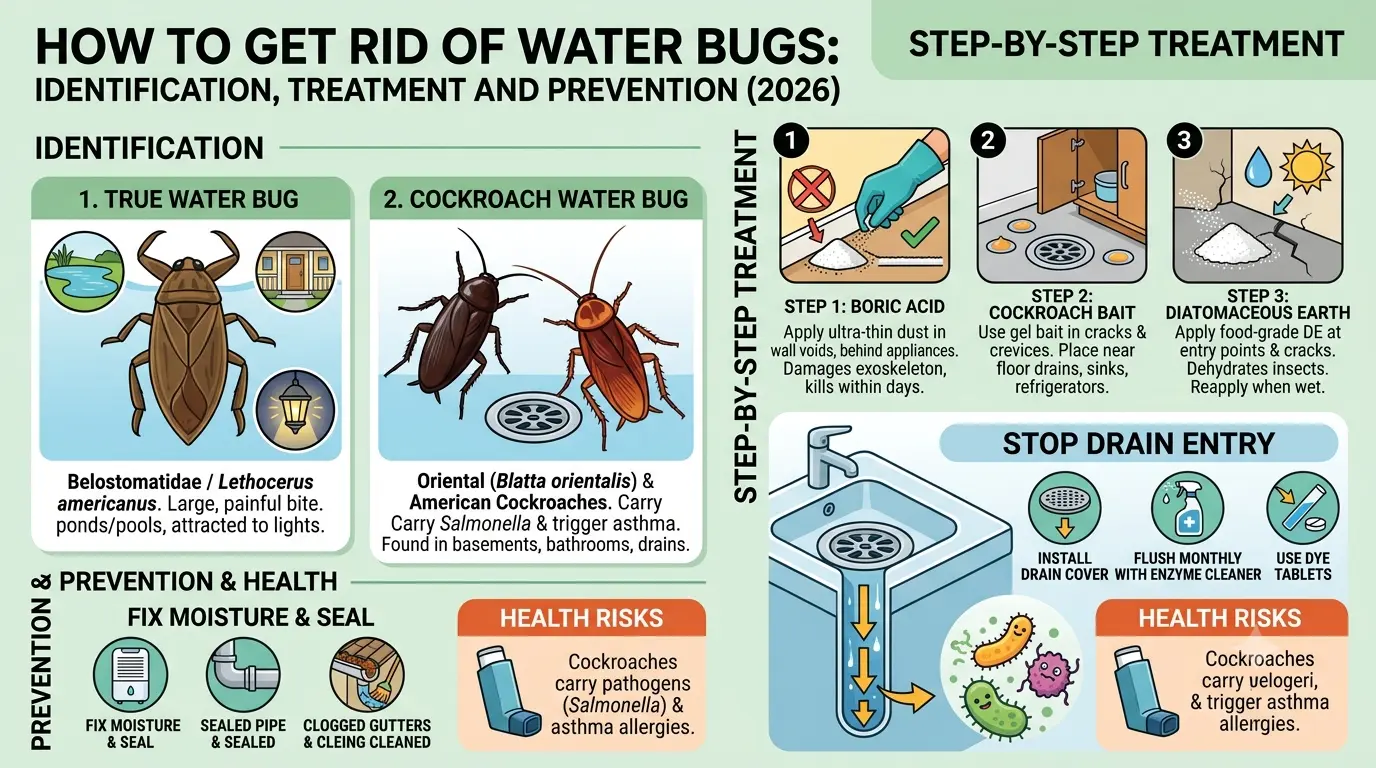
To get rid of water bugs, first confirm whether you have a true water bug or an Oriental cockroach — because nearly every indoor sighting is a cockroach, not a true aquatic insect. Apply boric acid in wall voids, use cockroach bait in cracks and crevices, seal every floor drain and foundation crack, and fix the underlying moisture problem driving them inside.
Most people spend weeks treating the wrong pest with the wrong product. That is why the water bug problem keeps coming back.
What Is a Water Bug and How Is It Different from a Cockroach?
The term “water bug” describes two completely different insects depending on where you find it. True water bugs belong to the family Belostomatidae and the species Lethocerus americanus. They live in freshwater ponds, streams, and lakes. They swim using cilia-covered hind legs and carry breathing tubes at their abdomen to breathe underwater. You will also hear them called toe biters and electric light bugs because they fly toward porch lights at night.
Oriental cockroaches (Blatta orientalis) and American cockroaches earned the “water bug” nickname simply because they love damp environments. These are the insects you almost certainly have when you spot one inside your home.
The key differences to know:
- True water bugs: oval body reaching 35 to 65mm, large front pincher appendages, hind legs built for swimming, found near freshwater ponds and pools
- Oriental cockroach: glossy dark brown body, 18 to 25mm, males have short wings that do not cover the abdomen, females are nearly wingless, found in basements and drains
- American cockroach: reddish-brown body up to 40mm, distinctive figure-8 pattern behind the head, can fly, found in sewers and large buildings
If you found the insect in your basement, bathroom, or drain, it is a cockroach. If it came from a pool or pond, it may be a true water bug.
Why Do Water Bugs Keep Coming Inside Your Home?
Oriental cockroaches enter homes searching for moisture, warmth, and food. They travel through floor drains, sewer drain pipes, pipe holes, and foundation cracks at ground level. Peak indoor activity runs from November through February when cold weather pushes them inward from outdoor hiding spots.
What draws them specifically to your property:
- Standing water from clogged gutters near the foundation
- Mulch beds pressed against exterior walls trapping moisture
- Garbage receptacles and recycling bins without tight lids
- Leaf litter and decaying vegetation near the structure
- Open pet food bowls left out overnight
- Uncovered storm drains near the building
True water bugs are attracted to porch lights between May and September and occasionally land in pools or enter through open doors. Their indoor visits are always accidental.
Are Water Bugs Actually Dangerous?
True water bugs deliver a painful bite using paralyzing venom to subdue prey. Bites cause pain, redness, and swelling but carry zero disease risk. They are a nuisance, not a serious health hazard.
Cockroach water bugs are different. Oriental cockroaches and American cockroaches carry Salmonella, Staphylococcus, and Streptococcus on their bodies. Their shed skins and droppings leave allergen proteins that trigger asthma in children and adults. The EPA lists cockroaches as documented asthma triggers in schools and homes.
Cockroach allergen proteins persist in carpets, wall voids, and upholstery for months after treatment. HEPA vacuum all affected areas after eliminating the insects to remove residual allergen proteins still triggering reactions.
How to Get Rid of Water Bugs in Your House Step by Step
The most effective approach works in layers. One product alone rarely solves an established infestation.
Step 1: Use Boric Acid Correctly
Boric acid is the most effective DIY treatment for cockroach water bugs and also the most misapplied. Apply an ultra-thin dust layer barely visible to the eye. Heavy piles repel cockroaches instead of killing them.
Apply boric acid dust:
- Along baseboards in basements and utility rooms
- Inside wall voids behind outlet covers
- Under and behind water heaters and appliances
- Along pipe runs in crawl spaces
Cockroach nymphs and adults walk through the dust, damaging their exoskeleton and digestive system. Death follows within days of contact.
Step 2: Add Cockroach Bait and Sticky Traps
Place gel cockroach bait in cracks and crevices where you spot activity. Behind the refrigerator, under the sink, and along floor drain edges are the highest return locations. Sticky traps placed along baseboards near floor drains tell you exactly where movement is concentrated so you can target those spots precisely.
Do not place boric acid and bait in the same spot. Boric acid repels insects away from bait stations.
Step 3: Apply Food-Grade Diatomaceous Earth at Entry Points
Food-grade diatomaceous earth works differently from boric acid. It damages the exoskeleton on contact and causes dehydration rather than poisoning. Scatter a thin layer around foundation cracks, entry points, and near floor drains. It loses effectiveness when wet, so reapply after rain or mopping.
What About Bug Spray and Bug Bombs?
Skip them. Bug spray and bug bombs are largely ineffective against cockroach water bugs and push them deeper into wall voids, crawl spaces, and drain systems rather than eliminating the colony. Residual insecticide applied as a professional crack and crevice treatment produces far better results than any aerosol product you can buy off the shelf.
How to Stop Water Bugs Coming Up Through Drains
Floor drains and sewer drain pipes are the primary entry route for cockroach water bugs in bathrooms and basements. Here is the drain-specific protocol that no competitor covers:
- Fit every ground-level drain with a floor drain cover immediately
- Flush drains monthly using an enzyme-based drain cleaner to remove organic matter that feeds and attracts them
- Use dye tablets in floor drains to confirm which drains connect directly to active sewer lines before you seal them
- Apply foam insecticide into the drain cavity around pipe penetrations in the floor as an additional barrier
This drain protocol is the step most DIY treatments skip entirely, which is why cockroach water bugs keep returning despite repeated treatment.
How to Get Water Bugs Out of a Swimming Pool
True water bugs land in pools while flying toward lights between May and September. Use a pool skimmer net to scoop them from the surface and run the pool vacuum for any submerged ones. Dim porch and pool lights after dark during peak flight season as light is the primary attraction pulling electric light bugs toward your property. Trim aquatic vegetation around the pool perimeter that provides resting habitat.
How to Get Rid of Water Bugs in an Apartment
Apartment control differs from a single-family home. Shared sewer lines, shared wall voids, and exterior foundation areas outside your control mean unit-level treatment rarely produces lasting results. What you can control:
- Seal every pipe hole with silicone-based caulk
- Install floor drain covers on every ground-level drain
- Place cockroach bait stations under the sink and near the water heater
- Report the infestation to building management in writing
Oriental cockroach infestations in multi-unit buildings require building-wide baiting protocol and sewer system entry blocking. Unit treatment buys time but does not fix the shared infrastructure source.
Can You Smell a Water Bug Infestation Before You See It?
Yes. Oriental cockroaches produce a distinctive musky roachy odor that grows stronger as the population increases. Use this as a severity guide:
- Faint musty smell in the basement or crawl space: low-level activity, DIY treatment with boric acid and sticky trap monitoring is appropriate
- Moderate musty odor throughout the laundry room or utility room: moderate infestation, intensify treatment and add a dehumidifier to reduce humidity
- Strong persistent musky roachy odor across multiple rooms: advanced infestation requiring professional pest control and a customized treatment plan immediately
Most people ignore early odor warnings and wait until they see insects in visible areas, by which point the infestation has already spread significantly.
The IPM Approach That Actually Works Permanently
Integrated pest management (IPM) is the only framework that eliminates water bugs permanently rather than temporarily reducing the population.
The correct sequence:
- Night inspection with a flashlight to identify entry points and activity zones
- Sanitation protocol: remove food debris, seal garbage receptacles, fix moisture
- Exclusion method: seal foundation cracks and pipe holes before any chemical treatment begins
- Monitoring trap placement near floor drains to measure activity weekly
- Targeted treatment with boric acid and cockroach bait only after steps 1 to 4 are fully in place
Skipping to chemical treatment without the first four steps is the single most common reason DIY water bug treatment fails.
How to Prevent Water Bugs From Coming Back
Permanent prevention requires fixing the moisture problem that made your home attractive in the first place:
- Seal foundation cracks and pipe holes before November when Oriental cockroaches move indoors for winter
- Pull mulch at least 12 inches from the foundation
- Fix clogged gutters and eliminate standing water near the perimeter
- Install door sweeps on ground-level entry doors and window screens on basement windows
- Run a dehumidifier in the basement to reduce humidity
- In spring when nymph emergence peaks, refresh boric acid applications
When Should You Call a Professional Exterminator?
Call a pest control professional when:
- The musky roachy odor is present throughout multiple rooms
- Sticky traps capture dozens of Oriental cockroaches within 24 hours
- You find ootheca (egg cases) in multiple locations inside the home
- Two weeks of DIY boric acid and cockroach bait treatment has produced no measurable reduction in trap catches
- You live in an apartment where shared infrastructure makes solo treatment structurally impossible
A professional provides a customized treatment plan, accesses wall voids and sewer entry points that you cannot reach, and applies residual insecticide formulations that outperform anything available to consumers.
Final Thoughts
Knowing how to get rid of water bugs permanently comes down to one principle: treat the conditions, not just the insects. Boric acid, cockroach bait, and diatomaceous earth eliminate the active population. Sealing floor drains, foundation cracks, and pipe holes with silicone-based caulk stops re-entry. Fixing the moisture problem removes the reason they chose your home in the first place. If the musky roachy odor persists after two weeks of treatment, call a professional. Water bugs do not leave on their own.
FAQs
Can water bugs come up through drains?
Yes. Oriental cockroaches and American cockroaches regularly travel through sewer drain pipes and emerge through floor drains in basements and bathrooms. Install floor drain covers, flush drains monthly with enzyme-based drain cleaner, and use dye tablets to confirm which drains connect to active sewer lines.
Do water bugs bite?
True water bugs (toe biters) bite using paralyzing venom and cause significant pain, redness, and swelling. Cockroach water bugs found indoors almost never bite but pose ongoing health risks through Salmonella, allergen protein exposure, and asthma triggers that affect children most severely.
How long does it take to get rid of a water bug infestation?
A light infestation treated with boric acid and cockroach bait typically resolves in 2 to 4 weeks. Moderate infestations take 4 to 8 weeks. Severe infestations with ootheca in multiple locations and a strong musky roachy odor require professional pest control and 2 to 3 months given the 6 to 8 week egg hatch cycle.
Why do water bugs keep coming back after treatment?
Water bugs return when the root moisture problem is never fixed. Unsealed foundation cracks, untreated floor drains, and mulch against the foundation continue providing entry and habitat regardless of how many insects you kill indoors. Permanent elimination requires the exclusion method alongside any chemical treatment.
What is the fastest way to get rid of water bugs?
The fastest immediate knockdown combines gel cockroach bait in cracks and crevices with food-grade diatomaceous earth along baseboards and entry points. For a single true water bug found indoors, a flyswatter handles it directly. For lasting results, seal entry points with silicone-based caulk and eliminate moisture sources the same day you start treatment.
Are water bugs dangerous to pets?
True water bugs can bite dogs and cats that handle them, causing pain and swelling. Cockroach water bugs transfer Salmonella and Staphylococcus to pet bowls and feeding areas. Keep pet food sealed in airtight containers overnight since open bowls actively attract Oriental cockroaches and American cockroaches into kitchen and laundry areas.