
What Causes Itchy Feet and How to Stop Them for Good
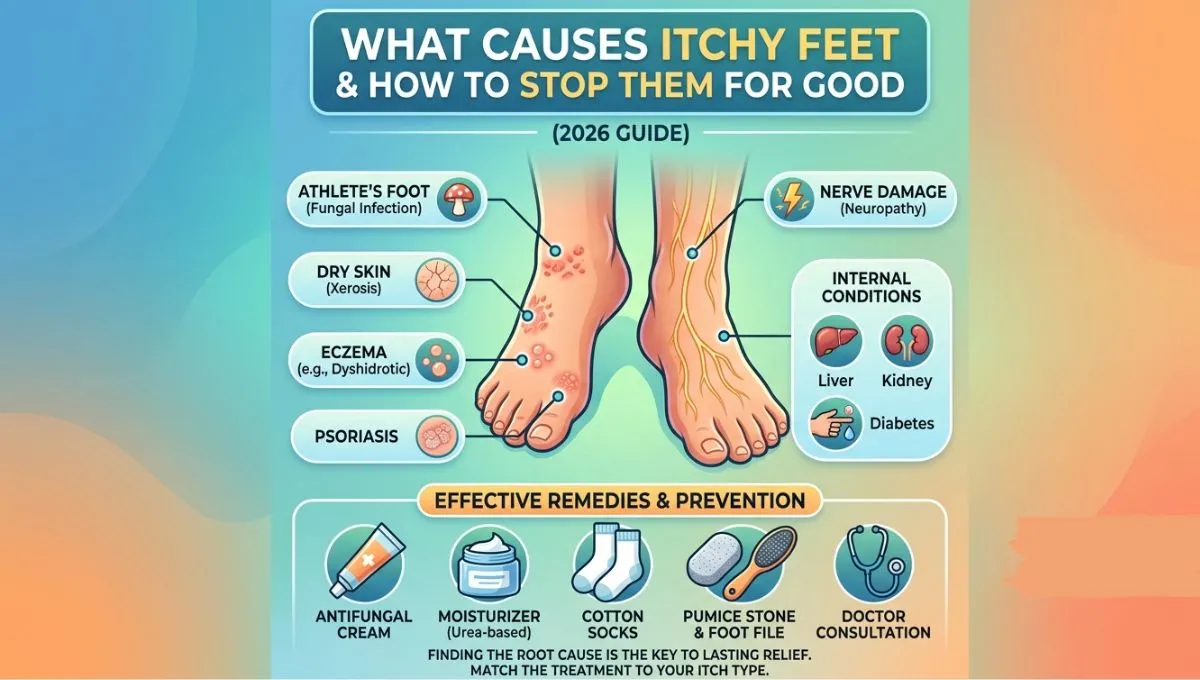
Itchy feet, medically called pruritus, are triggered by athlete’s foot (tinea pedis), dry skin (xerosis), eczema, psoriasis, scabies, nerve damage, or internal conditions like diabetes, liver disease, and kidney disease. The itch can start in your skin, your nerves, or even your organs. Knowing which type you have is the only path to lasting relief.
Most people reach for antifungal cream first. That only works when fungus is actually the cause.
What Exactly Are Itchy Feet and What Does Pruritus Mean?
Pruritus is the medical term for itchiness. When feet itch, the trigger is not always something visible on the skin. The body fires the itch pathway for four distinct reasons:
- Cutaneous itch: Originates from a problem directly on or in the skin
- Systemic itch: Caused by an internal condition affecting the whole body
- Neuropathic itch: Fired by damaged nerves sending false signals to the brain
- Psychogenic itch: Triggered by chronic stress, anxiety, or psychological causes
This distinction matters more than most people realize. A neuropathic itch gets zero response from antifungal cream. A systemic itch does not respond to moisturizer. Matching the treatment to the correct itch type is where most people go wrong, and where competitors leave you without proper answers.
What Are the Most Common Causes of Foot Itch in 2026?
Based on current dermatology and podiatry research, here are the most confirmed causes:
- Athlete’s foot (tinea pedis): A contagious fungal infection affecting 15 to 25 percent of people at any given time
- Dry skin (xerosis cutis): Especially common in cold climates and in adults over 60
- Dyshidrotic eczema: Produces deep, bubble-like blisters on the soles and sides of feet
- Plaque or pustular psoriasis: An autoimmune condition causing thick, scaly, extremely itchy skin plaques
- Scabies: Microscopic mites that burrow into the skin and intensify itching at night
- Contact dermatitis: An allergic skin reaction to shoe materials, fabric dyes, or laundry detergent
- Peripheral neuropathy: Nerve damage that sends itch signals with no skin trigger at all
- Systemic conditions: Diabetes, liver disease, chronic kidney disease, and thyroid dysfunction
Each cause produces a different itch pattern. Athlete’s foot targets between the toes. Dyshidrotic eczema blisters the sole. Neuropathic itch burns constantly and does not ease with scratching.
Is It Always Athlete’s Foot? What Tinea Pedis Actually Does
Athlete’s foot is the most assumed cause of foot itch and also the most frequently misidentified one. Tinea pedis is a contagious fungal infection that thrives in warm, moist environments including inside shoes, locker rooms, and communal pools.
It causes a scaly rash starting between the toes, intense itching with a burning sensation, peeling skin, blisters, and in severe cases toenail discoloration and skin that cracks and bleeds. It does not clear on its own without antifungal treatment.
Dyshidrotic eczema looks similar at first glance but behaves completely differently. It produces small, deep, intensely itchy blisters on the soles and sides of feet. It has no fungal origin. Its triggers include nickel and chromium exposure, excessive moisture, stress, and laundry detergent residue. Applying antifungal cream to dyshidrotic eczema provides zero relief and delays the correct treatment by weeks.
If the rash starts between the toes and spreads outward, think fungal. If blisters appear on the sole with no rash between the toes, think eczema. This single distinction can save you from weeks of wrong treatment.
Can Dry Skin (Xerosis) Cause Foot Itch with No Rash?
Yes. Xerosis cutis is a leading cause of foot itch that produces no visible rash and no fungal signs. Here is why feet are especially vulnerable: they have no sebaceous glands. That means they produce zero natural oil and depend entirely on external moisturization to stay hydrated.
When feet lose moisture due to cold temperatures, low humidity, weight-bearing stress, harsh soaps, or aging, the skin turns rough, flaky, and persistently itchy. Untreated xerosis progresses to deep heel cracks, painful skin fissures, and thick callus buildup.
The most effective fix is a urea-based foot cream with 10 to 25 percent urea, applied within five minutes of bathing. At bedtime, petroleum jelly covered by cotton socks locks in moisture overnight. Alpha hydroxy acid and ceramide-based creams also rebuild the skin barrier effectively.
Aging accelerates this significantly. As skin thins and loses its ability to retain water, dead skin buildup and chronic xerosis become persistent daily problems, particularly in adults over 60.
Why Does Foot Itch Always Get Worse at Night?
This is one of the most searched questions about pruritus. Most competitors give the shortest, vaguest answers. Here is what actually happens:
- Body temperature drops after sleep onset and this accelerates skin moisture loss
- Fewer sensory distractions at night cause the brain to amplify the itch signal
- Scabies mites are biologically most active during nighttime hours
- Liver disease and peripheral neuropathy both follow nocturnal itch patterns
- Psychogenic pruritus intensifies when the mind has no other focus
The scratch-itch cycle makes nighttime itch significantly worse. Scratching triggers serotonin release from the brain, which temporarily calms the signal but then intensifies it seconds later. The skin barrier takes damage with every scratch, raising the risk of secondary infection.
Can Foot Itch Signal a Serious Internal Disease?
This is the question most competitors address only in passing. The honest answer is yes.
Liver disease causes bile salt accumulation in the bloodstream. These bile salts directly irritate skin nerves and produce intense cholestatic pruritus concentrated on the soles of feet and palms. Obstetric cholestasis, a liver condition specific to pregnancy, follows the same mechanism and carries fetal risk including preterm birth. Any pregnant person with severely itchy soles needs urgent medical assessment.
Chronic kidney disease (CKD) in its advanced stage causes uremic pruritus. Toxins and waste products that healthy kidneys would filter instead build up in the blood and trigger severe itching on the soles. Standard moisturizers do nothing here. Treatment requires phototherapy or adjusted dialysis protocols.
Diabetes causes diabetic neuropathy by allowing high blood sugar to damage nerve fibers starting in the feet. The result is tingling, burning, and persistent pruritus that standard foot treatments cannot address. Diabetic dry skin independently causes foot itch as a separate complication. Both require professional diabetic foot assessments.
Thyroid dysfunction is frequently overlooked. Hyperthyroidism associates directly with generalized pruritus. Hypothyroidism causes severe xerosis and chronic itchy feet as a primary symptom.
When moisturizers and antifungal cream both fail and the itch persists beyond two weeks, a systemic cause must be properly tested.
What Is Peripheral Neuropathy and How Does It Make Feet Itch?
Peripheral neuropathy means damage to the peripheral nervous system. When nerves in the feet sustain damage, they fire false itch signals to the brain even when no physical irritant exists. Scratching cannot relieve neuropathic itch because it has no skin-level source. Diabetes is the leading cause of this nerve damage in the feet.
Effective treatments include capsaicin cream, lidocaine patches, gabapentin (an anti-seizure medication repurposed for nerve itch), antidepressants, and transcutaneous nerve stimulation (TENS). Antifungal cream and moisturizers have no effect on neuropathic pruritus.
Can Stress and Anxiety Cause Foot Itch?
Yes. Psychogenic pruritus is a medically recognized condition in which chronic stress and anxiety activate the itch pathway through neurological mechanisms. The result is real, intense pruritus with no rash, no fungal infection, and no visible skin condition present.
Psychological stress pushes the nervous system into heightened sensitivity and triggers serotonin release. During periods of high anxiety, sleep deprivation, or emotional overwhelm, feet can itch intensely with no external explanation. The itch is completely real. The origin is neurological, not imaginary.
Can Shoes and Socks Cause Foot Itch?
Yes, and most people never suspect it. Shoe leather, rubber insoles, synthetic linings, and fabric dyes are documented contact allergens that trigger contact dermatitis on the feet. The resulting redness and itch follow the exact contact zone of the shoe or sock, which distinguishes it clearly from athlete’s foot.
Laundry detergent residue left in socks is another common trigger. A dermatologist can identify the specific allergen through patch testing and eliminate the cause permanently.
Why Do Feet Itch During Exercise? (Cholinergic Urticaria)
Exercise-induced foot itch may indicate cholinergic urticaria, a condition that causes hive-like skin inflammation on the soles when body heat and sweat rise during physical activity. The itch begins during or shortly after exercise and does not respond to antifungal cream, foot powder, or standard moisturizers. It requires dermatological evaluation and is frequently mistaken for athlete’s foot in active individuals.
How to Build a Foot Care Routine That Prevents the Problem
Prevention is where all competitor articles fall short. They cover the cause. They list a treatment. Then they stop. Here is a complete prevention-first routine for 2026.
Daily habits:
- Wash feet with a mild, fragrance-free cleanser and dry thoroughly between every toe
- Apply a ceramide or urea-based foot cream within five minutes of bathing
- Wear moisture-wicking socks and breathable footwear every day
- Use foot powder if feet sweat heavily to prevent fungal and bacterial growth
Weekly habits:
- Soak feet in warm water with Epsom salt for 10 to 15 minutes to soften dead skin buildup
- Use a pumice stone or foot file on thickened areas only after soaking, never on dry or broken skin
- Exfoliate once or twice per week maximum
- Apply shea butter or petroleum jelly immediately after each session
If you have diabetes, skip pumice stone exfoliation entirely. A single small cut from aggressive filing can become a serious complication when diabetic neuropathy has reduced sensation in your feet.
When Should You See a Podiatrist or Doctor?
See a podiatrist or doctor when:
- Foot itch persists for more than two weeks without improvement
- OTC antifungal cream and moisturizers both fail completely
- You notice thick crusting, deep blisters, or a spreading rash
- Itch comes with tingling, numbness, or a burning sensation
- You have diabetes, liver disease, or kidney disease and develop new foot symptoms
- Itch peaks at night with no visible skin cause
Do not delay if you are diabetic. Foot complications in diabetic patients escalate quickly and require specialized care, not home trial and error.
Final Thoughts
Itchy feet are not always something a cream can fix. They can signal athlete’s foot, dry skin, eczema, nerve damage, or a deeper problem like diabetes, liver disease, or kidney failure. The location, timing, and pattern of your itch give you the clearest clues. Treat the root cause and not just the symptom, and most cases resolve completely. If the itch lasts more than two weeks or gets worse at night with no visible cause, that is your signal to see a doctor.
FAQs
What causes itchy feet with no rash?
Foot itch with no visible rash is most commonly caused by peripheral neuropathy, liver disease (cholestatic pruritus), chronic kidney disease (uremic pruritus), thyroid dysfunction, psychogenic pruritus, or aquagenic pruritus. When moisturizers fail and no rash appears, a systemic or neurological cause needs medical testing.
Is itchy feet a sign of poor circulation?
Foot itch is not a primary symptom of poor circulation. Diabetic neuropathy, caused by high blood sugar damaging nerves and circulation together, produces tingling, numbness, and pruritus. Poor circulation itself more typically causes coldness, pain, and numbness rather than active itching.
Can foot itch spread to hands?
Yes. Scabies mites starting between the toes spread to the hands through skin contact. Athlete’s foot fungus transfers to hands if you scratch infected feet without washing immediately after. Dyshidrotic eczema frequently appears on both feet and hands at the same time.
What causes itchy hands and feet at night with no rash?
Nighttime itch in hands and feet with no rash strongly indicates scabies, liver disease (bile salt-driven pruritus), peripheral neuropathy, or psychogenic pruritus. Xerosis also intensifies at night as the body loses skin moisture during sleep. The absence of a rash does not mean the cause is harmless.
Can pregnancy cause foot itch?
Yes. Pruritus gravidarum and obstetric cholestasis are pregnancy-specific conditions causing severe foot itch. Obstetric cholestasis produces cholestatic pruritus on the soles and palms and raises fetal risk including preterm birth. Dyshidrotic eczema and psoriasis can also worsen temporarily during pregnancy.
Can itchy feet indicate cancer?
In rare cases, yes. Squamous cell carcinoma can develop on the feet and produce painless but itchy lesions. Blood cancers including leukemia, lymphoma, and polycythemia rubra vera are among the most common cancer-related causes of pruritus. Persistent, unexplained foot itch that responds to nothing over several weeks always warrants full medical evaluation.