
Is Imitation Crab Healthy? Nutrition Facts, Additives, Risks, and Who Should Avoid It
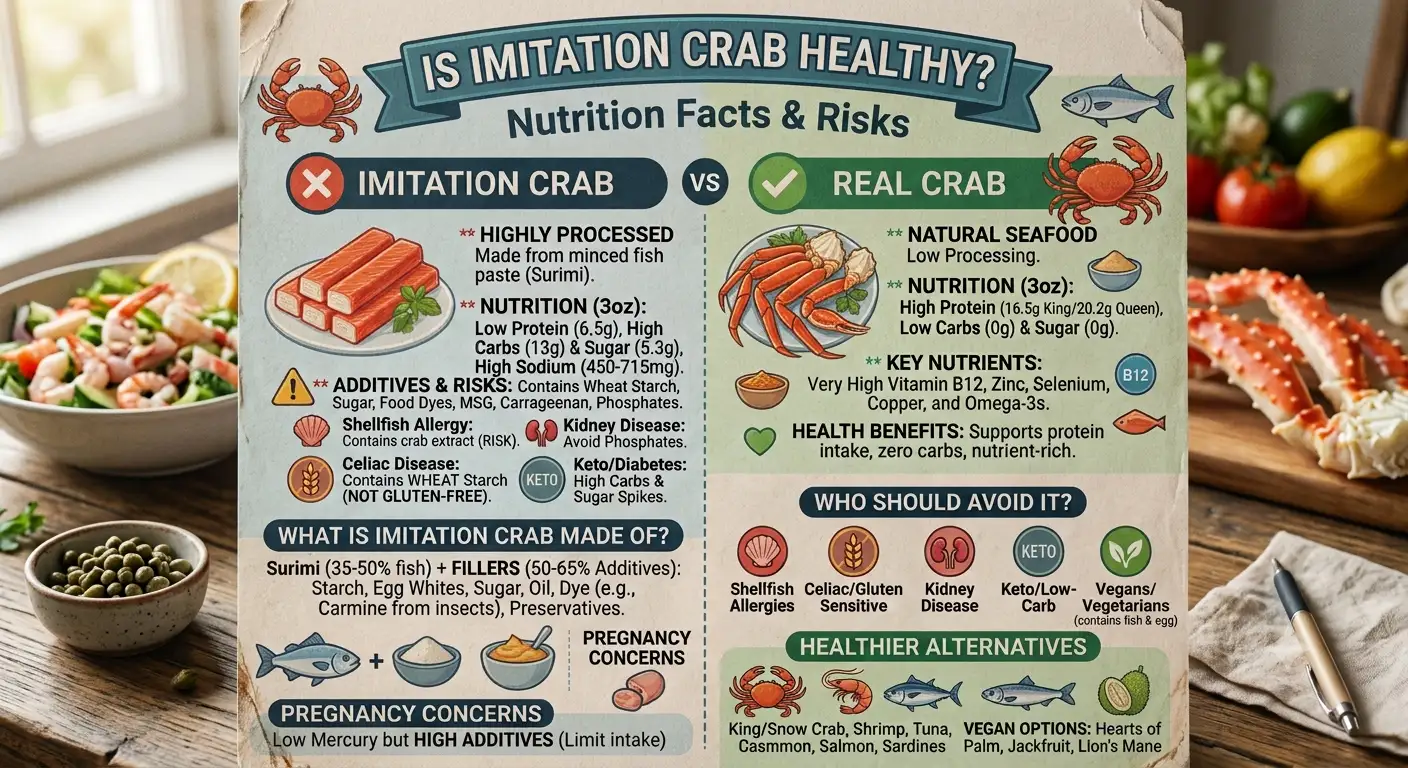
Imitation crab is not particularly healthy. It is a highly processed food made from surimi, a minced fish paste blended with starch, sugar, food dyes, and preservatives. It is low in calories but also low in protein, high in carbohydrates, and loaded with additives. Most healthy adults can eat it occasionally without harm, but several specific groups should avoid it entirely.
Most people eat imitation crab regularly without giving it a second thought. It shows up in California rolls, crab rangoon, seafood salad, and crab cakes at restaurants everywhere. The problem is that most people assume seafood automatically means healthy. That assumption does not hold up once you look at what surimi actually contains.
Is Imitation Crab Healthy Compared to Real Crab?
The honest answer is no, not even close. A 3 oz serving of imitation crab delivers only 6.5 grams of protein while the same portion of Alaskan king crab provides 16.5 grams and queen crab delivers 20.2 grams. Both contain around 81 to 98 calories per serving but the way those calories are built is completely different.
Real crab meat gets roughly 80% of its calories from protein. Imitation crab gets 63% of its calories from carbohydrates. That carb content comes from wheat starch, potato starch, tapioca starch, and sugar added during surimi processing, none of which exist in natural crab.
The vitamin and mineral gap is equally dramatic:
- Vitamin B12: Imitation crab provides 21% of the daily value. Alaskan king crab provides 408%.
- Zinc: Imitation crab provides 3% of the daily value. King crab provides 59%.
- Selenium: Imitation crab provides 35% of the daily value. King crab provides 62%.
- Copper: Imitation crab provides 3% of the daily value. King crab provides 111%.
- Omega-3 fatty acids: Imitation crab contains very low levels. Real crab delivers meaningful amounts.
Imitation crab also contains virtually no folate, vitamin C, or meaningful magnesium compared to real crab. And while real crab tends to be higher in sodium, the 450 to 715 mg per 3 oz serving in imitation crab still contributes significantly toward the daily 2,300 mg limit.
What Is Imitation Crab Actually Made Of?
Imitation crab is made from surimi, which is fish flesh that has been deboned, washed multiple times to remove fat, odor, and color, then minced into a smooth paste. Surimi accounts for only 35% to 50% of the final product by weight. The remaining 50% to 65% is a combination of additives, fillers, and binders.
The core ingredients include:
- Water, the second most abundant ingredient after surimi
- Wheat starch, potato starch, tapioca starch, or corn starch to firm up texture
- Egg whites and soy protein to boost protein and improve glossiness
- Sugar and sorbitol to help the product freeze and thaw without breaking down
- Vegetable oil such as sunflower or soybean oil for shelf life and color
- Salt (sodium chloride) and sometimes potassium chloride for flavor and gel structure
After blending, manufacturers heat and press the mixture into crab-leg shapes, dye it red or orange using carmine extracted from insects or paprika extract, then pasteurize and vacuum seal it. The product was first patented by Sugiyo, a Japanese company, in 1973. Today 2 to 3 million tons of fish annually, roughly 2% to 3% of the world fisheries supply, go into producing surimi-based seafood products globally.
What Additives Are in Imitation Crab and Are They Safe?
This is where things get more concerning. Beyond the basic ingredients, most commercial imitation crab contains a significant list of food additives. The FDA grants GRAS (Generally Recognized as Safe) status to most of them, but several carry documented health concerns.
Carrageenan acts as a gelling and stabilizing agent in surimi products. Animal and test-tube studies link carrageenan to intestinal damage, inflammation, and increased intestinal permeability commonly called leaky gut. Some research associates it with higher cancer risk in animal models. The FDA maintains its GRAS classification but researchers continue calling for more human studies.
Monosodium glutamate (MSG) and its related compound disodium inosinate are added to many brands to enhance the seafood flavor. People sensitive to MSG report headaches, muscle tightness, weakness, and numbness after eating foods that contain it. To spot MSG on a label look for monosodium glutamate, glutamic acid, or glutamate in the ingredients list.
Carmine is the red food dye that gives imitation crab its distinctive orange-red color. It comes from tiny insects called cochineals. Some brands use paprika, beet juice extract, or lycopene from tomatoes as alternatives, but carmine remains the most common colorant in surimi-based products.
Phosphate-based preservatives and sodium benzoate are standard in most commercial imitation crab to extend shelf life. People with kidney disease are specifically advised to avoid foods containing added phosphates because damaged kidneys cannot filter excess phosphorus properly, leading to dangerous buildup that harms blood vessels and bone density.
Who Should Avoid Imitation Crab Entirely?
People with shellfish allergies are at serious risk because most brands add a small amount of crab extract for flavor. Even trace amounts can trigger a reaction. Mislabeling makes this worse. A study of 16 surimi-based products in Spain and Italy found that 25% listed a different fish species than what DNA analysis confirmed. Two of those mislabeled products contained species linked to ciguatera poisoning, the most common toxin-based seafood illness. Avoid all unlabeled imitation crab at restaurants and parties.
People with celiac disease or gluten sensitivity face exposure through wheat starch, a standard ingredient in most imitation crab brands. Eating even small amounts of gluten can cause abdominal pain, diarrhea, bloating, and fatigue in sensitive individuals. Long-term exposure increases intestinal permeability in those with celiac disease. Some brands offer gluten-free versions using tapioca starch, potato starch, or pea starch instead.
People with kidney disease should avoid imitation crab because of phosphate additives used as preservatives. Compromised kidneys cannot eliminate excess phosphorus, which accumulates and causes blood vessel and bone damage. Anyone on dialysis should treat imitation crab as an off-limits food.
Keto and low-carb dieters are often surprised to discover that a single 3 oz serving contains 13 grams of net carbs including 5.3 grams of added sugars. That is far too high for maintaining ketosis. Real crab, crayfish, shrimp, and wild-caught salmon all contain zero carbohydrates and work far better on a ketogenic diet.
Vegans and vegetarians should know imitation crab is not plant-based. It contains fish as the primary ingredient plus egg whites, making it unsuitable for both diets regardless of its processed appearance.
Is Imitation Crab Good for Diabetics?
Blood sugar management is a real concern here. The combination of wheat starch, potato starch, corn starch, tapioca starch, and sorbitol delivers 12.8 to 13 grams of rapidly digestible carbohydrates per 3 oz serving. Because imitation crab contains virtually zero dietary fiber, these carbs absorb quickly and cause a fast blood sugar spike followed by a sharp drop.
For people with type 2 diabetes or insulin resistance this pattern is problematic. The 5.3 grams of added sugars per serving amplify the issue further. Real crab, shrimp, tuna, or sardines are zero-carb seafood alternatives that do not affect blood sugar and deliver far more protein per serving.
Is Imitation Crab Safe During Pregnancy?
On the mercury question, Alaska pollock is a small fast-reproducing fish that does not bioaccumulate heavy metals the way large predatory fish like tuna or mackerel do. Mercury levels in surimi are genuinely low, placing it among safer seafood options on that specific measure.
However the additive load creates separate concerns. MSG, carmine, carrageenan, sodium benzoate, and phosphate preservatives are all present in most commercial brands. Most experts recommend limiting imitation crab during pregnancy and checking with a doctor before making it a regular prenatal food, not because of mercury but because of these additives.
What Are Healthier Alternatives to Imitation Crab?
For protein and real seafood flavor, choose king crab, snow crab, crayfish, shrimp, or tuna. Each provides 14 to 24 grams of protein per 3 oz serving with zero carbohydrates and no added sugars or artificial preservatives.
Wild-caught salmon and sardines are the best choices if omega-3 fatty acids and DHA are your priority. A serving of wild-caught salmon delivers 11 grams of healthy fat, 17 grams of protein, zero carbs, and meaningful amounts of vitamins B12, B6, niacin, riboflavin, and selenium.
If you want plant-based options that mimic crab texture for recipes like crab cakes or dips, hearts of palm, jackfruit, artichoke hearts, and lion’s mane mushroom all work well without a single synthetic additive. For the same fish base without the processing, pollock fish prepared simply is the most direct upgrade since surimi starts as pollock but loses much of its nutritional value through washing and processing.
Final Thoughts
Imitation crab is not going to harm a healthy person who eats it occasionally in a sushi roll or salad. But the idea that it is a healthy seafood choice simply does not hold up against the nutrition data. Low protein, high processed carbs, 5.3 grams of added sugars per serving, and a dense additive list including carrageenan, MSG, carmine, and phosphate preservatives separate it firmly from real whole seafood. For anyone managing diabetes, kidney disease, celiac disease, or a shellfish allergy, imitation crab creates real risks that make avoidance the smarter call. If cost is your concern, tuna, sardines, and shrimp deliver dramatically superior nutrition at comparable or lower prices. Read the label, know what you are actually buying, and choose seafood that genuinely supports your health.
FAQs
What is imitation crab made of?
It is made from surimi, a paste of deboned and minced Alaska pollock blended with wheat starch, egg whites, sugar, vegetable oil, salt, carmine food dye, and preservatives. Surimi accounts for 35% to 50% of the product by weight.
Is imitation crab real crab?
No. It contains virtually no real crab meat, only a trace amount of crab extract for flavor in some brands. The product is primarily processed Alaska pollock shaped and colored to resemble shellfish.
Is imitation crab keto friendly?
No. It contains 13 grams of net carbs per 3 oz serving from added starch and sugar. King crab, queen crab, shrimp, and crayfish are zero-carb seafood alternatives that actually support ketosis.
Can people with shellfish allergies eat imitation crab?
Not safely. Most brands contain crab extract and mislabeled products may contain undisclosed shellfish species. Those with shellfish allergies should avoid all unlabeled or restaurant-served imitation crab.
Is imitation crab gluten free?
Not typically. Standard products contain wheat starch. Some brands use tapioca starch or pea starch as gluten-free alternatives, so checking the label is essential for anyone with celiac disease.
Is imitation crab safe during pregnancy?
It is low in mercury but the additives including MSG, carrageenan, and phosphate preservatives make it a product to minimize during pregnancy. Check with your doctor before eating it regularly while pregnant.
Is imitation crab bad for kidneys?
Yes, for people with kidney disease. The phosphate additives cannot be properly filtered by compromised kidneys, leading to dangerous phosphorus buildup that damages blood vessels and bones over time.
Is imitation crab vegan?
No. It contains fish as the primary ingredient and egg whites as a binder. Hearts of palm, jackfruit, and lion’s mane mushroom are plant-based alternatives that mimic crab texture in recipes.
Does imitation crab have MSG?
Many brands add monosodium glutamate and disodium inosinate for flavor enhancement. Look for glutamate, monosodium glutamate, or glutamic acid on the ingredient label to identify its presence.
Can you eat imitation crab straight from the package?
Yes. It is fully precooked during pasteurization before vacuum sealing. You can eat it directly from the package in cold dishes or heat it for use in crab cakes, pasta, chowders, and stir-fries.
What fish is imitation crab made from?
Most imitation crab uses Alaska pollock as its base. Some manufacturers also use cod, Pacific whiting, squid, or mackerel depending on availability and cost.
Is imitation crab good for weight loss?
It is low in fat and calories but high in processed carbs and added sugar. For weight loss, shrimp, tuna, or wild-caught salmon deliver far more protein per serving which promotes satiety and supports better body composition.


