Pub Quiz Questions: The Complete Guide to Categories, Formats, and Hosting a Winning Quiz Night
What Are Pub Quiz Questions?
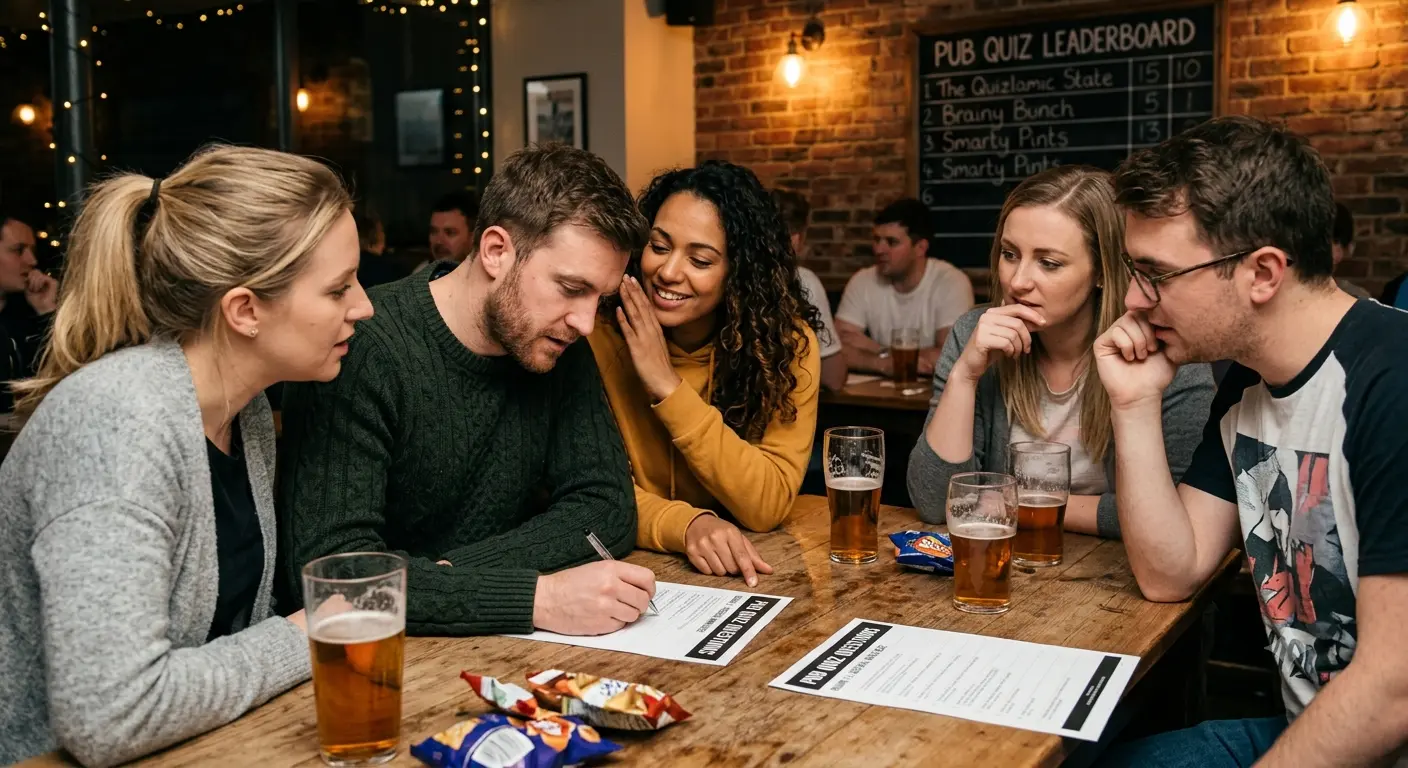
These are the prompts a quizmaster reads out or hands out on paper during a quiz night at a pub or bar. They get grouped into rounds by topic, such as general knowledge, sport, or music. Each round usually holds eight to ten questions. Teams write their answers on a sheet and hand it in at the end of the round. The quizmaster or a helper marks the scores before the next round starts.
The format spread from British pubs in the 1970s. It now runs in bars, halls, offices, and living rooms around the world. Questions can be spoken out loud, printed on a sheet, or played through speakers for a music round. The goal stays simple. Give a mixed group of strangers or regulars a reason to work together and enjoy a bit of friendly competition.
Where Did Pub Quizzes Come From?
The pub quiz became part of British culture after it was made popular in the UK during the 1970s. Much of the credit goes to Burns and Porter, who built a touring quiz business around the format. The earliest print mentions of something like a pub quiz go back to 1959. It still took another decade or two before the format became a regular fixture in British pubs.
From there it spread to Irish pub culture and then around the world, picking up local twists along the way. The UK kept the word quizmaster. American bars leaned toward trivia host instead. Today the tradition covers everything from a quiet quiz for six regulars to weekly leagues with dozens of competing teams.
What Makes a Good Pub Quiz Question?
A good pub quiz question has one answer that nobody can seriously argue with. It tests memory rather than luck, and it gives the table a small payoff when the answer comes out. Vague or poorly worded questions cause more arguments than hard ones ever do. Precision matters more than difficulty.
Experienced quiz writers lean on one trick in particular: misdirection. The question is worded so most players guess the wrong answer first, with full confidence. A classic example asks what the main ingredient in an au gratin dish is. Most tables shout cheese. The real answer is breadcrumbs, since au gratin actually refers to the browned, crusted topping, not the cheese underneath it. That small gap between the confident guess and the real answer is what makes a question memorable.
A few habits separate strong questions from weak ones:
- Keep answers short, ideally one to four words, so marking stays fast and disputes stay rare
- Check every answer against two or three sources before you use it
- Avoid stacking several hard questions from the same category back to back
- Write questions that reward general knowledge, not obscure trivia only one person would know
Travelers consistently find that the quizzes people talk about the next day are the ones with a few misdirection style questions mixed into an easier round. Quizzes that stay hard from start to finish tend to wear a table down instead of winning it over.
What Are the Best Pub Quiz Categories?
Most strong pub quizzes rotate through a core set of categories instead of sticking to one topic all night. General knowledge, sport, history, geography, science, movies, TV, music, and pop culture cover most of the question banks used across current quiz sites. Family friendly and funny rounds round out a well balanced night.
General Knowledge Questions
General knowledge rounds blend everyday facts from history, geography, science, and culture into one mixed round. They work well as an opener. Nearly everyone at the table can answer at least a few, which builds early confidence before harder categories arrive.
Sports Questions
Sport is the most consistently included category across UK pub quizzes and US bar trivia alike. Good sport rounds mix well known events, like World Cup winners or Olympic host cities, with a couple of harder questions for the sports fans at the table. That way non fans are not shut out completely.
History Questions
History rounds cover major events, dates, and well documented figures. The strongest ones stick to widely taught history rather than obscure footnotes only a specialist would know. The goal is a shared moment of recognition, not a lecture.
Geography Questions
Geography questions ask about capitals, landmarks, rivers, and borders. They pair naturally with a picture round using flags or maps. Geography knowledge tends to scale well across ages and backgrounds, which makes it one of the safest categories to lean on.
Science Questions
Science rounds cover biology, chemistry, physics, and space at a general level. Most quiz writers sort these by difficulty, since science trivia splits sharply between common knowledge, like the chemical symbol for silver, and true specialist material.
Movie Questions
Movie rounds test plot details, actors, quotes, and box office trivia. They rank among the most requested categories across every major quiz site. A movie round pairs especially well with a picture round built from film stills or posters.
TV Questions
TV rounds cover shows, characters, and broadcast history. Nearly every quiz bank treats this as its own category, separate from movies. Recent, widely watched shows tend to spark more table talk than older or niche ones.
Music Questions
Music rounds combine standard trivia with a listening round. Hosts play song clips, intros, or even tracks reversed for players to identify. Editing tools like Audacity are commonly used by quiz writers to prepare these clips ahead of time.
Pop Culture and Entertainment Questions
Pop culture rounds cover celebrities, viral moments, and entertainment news. Several quiz sites call this their single biggest category by question count. It also needs refreshing the most often, since relevance fades fast here.
Family Friendly and Kids Questions
Family friendly rounds stick to age appropriate topics like children’s books, animated movies, and simple facts. That way mixed age teams can join in without anyone feeling left out. Several quiz platforms tag these questions separately so hosts can pull them into their own round.
Funny and Trick Questions
Funny and trick questions lean on wordplay, false assumptions, or riddles instead of pure memory. Use them sparingly to break up fact heavy rounds. They also work well as tiebreakers, since they reward quick thinking over memorized facts.
Other Popular Categories
Food and drink, literature, animals, technology, math, and art and culture rounds all show up across multiple quiz sites as smaller categories. Use them as single rounds for variety rather than a full quiz night built around just one.
What Types of Pub Quiz Rounds and Formats Are There?
Beyond category, pub quiz questions also vary by format. Multiple choice, open ended, picture rounds, music rounds, and novelty formats like the connections round all show up in a well built quiz night. Mixing formats keeps energy higher than an all recall quiz ever could.
Multiple Choice vs Open Ended Questions
Multiple choice questions are easier and faster to answer, since players can rule out wrong options. Open ended questions force real recall and feel more rewarding when a team gets one right. Most experienced quizmasters use a mix of both instead of picking one style all night.
Picture Rounds
A picture round hands out printed or projected images, such as flags, logos, film stills, or photos taken from an odd angle. Teams have to identify what they see. It ranks as one of the most popular non verbal formats across current quiz sites, since it gives visual thinkers a fair shot alongside trivia buffs.
Music and Listening Rounds
A music round plays song clips, intros, or reversed tracks for teams to identify. Sound quality can be a real problem in a loud room or over a video call, so test your setup ahead of time. Audacity remains a common tool for prepping these clips in advance.
Connections or Common Bond Rounds
A connections round, sometimes called a common bond round, gives ten clues that seem unrelated at first. All of them link back to one hidden theme, usually revealed by the final answer. This format is one of the most underused in typical pub quiz content, even though experienced quizzers love it. It rewards teams who spot patterns, not just teams who memorize facts.
Joker Rounds
A joker round lets each team pick one round in advance where their points get doubled. This adds a layer of strategy on top of pure knowledge. Teams that misjudge the difficulty of their chosen round risk wasting the joker completely, which adds real tension to the decision.
How Many Questions and Rounds Should a Pub Quiz Have?
Most experienced hosts land on five to eight rounds of eight to ten questions each. A typical night runs about two hours with a short break around the halfway point. That structure gives teams enough content to feel like they got their money’s worth, without dragging into a fourth hour where people start losing focus.
US style bar trivia tends to run a bit shorter. It often uses twenty to twenty five total questions across five to seven rounds, since the format leans more toward a casual night out. Virtual quizzes run shorter still. They typically use six to seven rounds of five to eight questions inside a sixty to ninety minute window, since attention drops faster on a screen than in a room.
If you are writing your first quiz, start simple. Try six rounds of eight questions, with one picture or music round mixed in for variety. Adjust from there once you see how your crowd responds to the pacing.
How Do You Write Trivia Questions People Cannot Just Google?
This is one of the most common frustrations among people who run regular quiz nights. Smartphones make it easy for a team to quietly search an answer. Most quiz content online never deals with this problem directly.
A few practical fixes actually work:
- Favor questions that need thinking or math, not a single fact you can search, such as asking for the sum of two dates instead of just one
- Use local or personal knowledge questions tied to your specific pub, town, or event, since these will not return a clean search result
- Read questions aloud instead of printing them, so there is no exact phrase for a team to type into a search bar
- Host on a mobile quiz app that can flag a player who leaves the app or takes too long to answer, which closes the smartphone loophole more directly than house rules alone
Locals recommend combining a strict no phones rule with a few Google resistant questions in every round. Relying on either trick alone tends to fail by the third or fourth round of the night.
How Do You Choose the Right Difficulty for a Pub Quiz?
A widely used rule among quiz writers is the 40 40 20 split: about 40 percent easy questions, 40 percent medium, and 20 percent genuinely hard. This split keeps casual players engaged early while still giving serious quiz fans something to chase later on.
Spreading difficulty across the whole quiz matters more than most new hosts expect. A common mistake first timers make is putting every easy question in round one and every hard question near the end. That causes weaker teams to check out once things get tough. Mix difficulty tiers within each round, instead of ramping up round by round, and every team stays in the game longer.
How Do You Host a Pub Quiz Successfully?
Hosting well depends as much on pacing and delivery as it does on the questions themselves. A host who reads clearly, keeps rounds moving, and judges answers with confidence will earn more repeat teams than one who simply writes the hardest trivia. Consistency matters too. A host who keeps the same format, start time, and general tone week after week builds a loyal, regular crowd. That turns a one off quiz night into a weekly habit.
What Pub Quiz Etiquette Should Hosts and Teams Follow?
There is an unwritten social contract at most quiz nights that rarely makes it into formal guides. Teams write answers quietly instead of shouting them across the room. Phones stay in pockets, except for the host’s own quiz app. Once the quizmaster gives a ruling, the room accepts it, even on a close call. Most seasoned hosts expect a bit of good natured grumbling about wrong answers, but not real arguing that slows down the night.
Entry fees fit this same casual, community feeling. Most regular pub quizzes in the UK charge around one to two pounds per person. That can rise to five or ten pounds for a bigger event that includes food, and charity quiz nights can run much higher. In the US, most bar trivia is free to play. The bar simply expects players to buy food and drinks instead of paying an entry fee.
How Do You Handle Disputed Answers Fairly?
Fair dispute handling starts before the quiz even begins. Check every answer against two or three sources so you walk in confident, not guessing under pressure. Write questions with one clear, correct answer and you will avoid most arguments before they start. Wording disputes happen often enough in informal pub quizzes that a few have even ended up in real legal fights over prize money in the UK. That shows how much precise phrasing matters.
When a dispute happens mid quiz, the most respected hosts explain their reasoning briefly, stand by the answer they wrote down, and move on quickly. They do not reopen the debate for the rest of the round.
What Prizes Should You Offer at a Pub Quiz?
Common pub quiz prizes include a bar tab, free drinks, cash pooled from entry fees, vouchers, branded merchandise, or small novelty items. These usually go to the top two or three teams. Some hosts also hand out spot prizes mid quiz for smaller wins, like the first team to answer a bonus question correctly. This keeps struggling teams engaged even once they are out of the running for the main prize.
What Tools and Platforms Can Help You Run a Pub Quiz?
Options range from free tools like Kahoot and Google Forms to purpose built platforms like Kwizkid, Mentimeter, and QuizWitz. Some venues also use dedicated quiz hardware. The right choice depends heavily on whether you are running an in person pub night or hosting virtually over Zoom or Microsoft Teams.
Free vs Paid Pub Quiz Question Sources: What Is the Real Difference?
Free question banks often gate their best content behind a membership area or an email signup. Paid platforms tend to be more upfront about what you actually get. Kahoot, for example, lets a host run a free game for up to ten players with no account needed. Its paid individual plans generally run from around three to thirty dollars a month, depending on features like AI question generation and larger player limits. Business and school plans climb much higher, often several hundred to several thousand dollars a year, but that tier is built for large organizations, not a weekly pub quiz.
For most home or pub hosts, a free tier plus a handful of self written questions covers the need entirely. Paying only starts to make sense once you need bigger player caps, branding, or AI assisted question generation on a regular basis.
Can AI Generate Trivia Questions?
Yes. Several major platforms now offer AI quiz generators that build a themed round from a short prompt in seconds. Here is the catch nobody mentions enough. AI generated questions are often the easiest kind for a player to look up mid quiz, since they tend to pull from widely available facts. If you use AI to generate questions, edit at least a few per round to make them genuinely hard to Google.
Is a Pub Quiz the Same as Trivia Night?
Largely yes, with a few regional differences worth knowing. The UK favors the word quizmaster and often charges a small entry fee that feeds into a cash prize. American bar trivia leans on the word trivia host and usually runs free to play, with the bar expecting players to order food and drinks instead. The core format stays the same on both sides of the Atlantic: a team based, round structured quiz night.
Most visitors say the biggest practical difference is arrival etiquette. UK pub quizzes often expect regulars to claim tables well before the quiz starts, sometimes an hour early at popular venues. US bar trivia crowds tend to be more relaxed about walk ins.
Conclusion
Writing strong trivia questions comes down to a few habits you can repeat every week. Mix your categories, balance your difficulty, keep answers checked and clear, and build in a few questions a phone cannot easily solve. None of that requires expensive tools or years of hosting experience. It just takes a willingness to plan the night with the same care you would put into any evening meant to bring a room full of strangers together.
Start with six rounds of eight balanced questions, add one picture or music round for variety, and adjust from there based on how your own crowd responds. The best pub quiz questions are not the hardest ones in the room. They are the ones people are still arguing about, happily, on their way out the door.
FAQs
Where can you find free trivia questions and answers?
Free question banks exist across dedicated trivia sites, quiz platform blogs, and printable resources. Quality and freshness vary a lot from site to site, so cross check a few different sources before you trust any single free bank at face value.
What is the best pub quiz question ever asked?
There is no single agreed on best question. But the ones quizzers remember years later share a pattern: a confident wrong guess followed by a satisfying, well earned correct answer. That is the misdirection effect at work, not luck.
How do you make a pub quiz more entertaining?
Mix your categories and formats, hire or become a charismatic host, and pace the night so you avoid long stretches of the same question type. Adding a picture or music round partway through also helps players who are not pure trivia specialists stay engaged.
What are good pub quiz team names?
Strong trivia team names tend to be punny, tied to pop culture, or a little self deprecating about the team’s odds of winning. Team naming is not a question format itself, but it is one of the most searched topics alongside pub quiz questions. Picking a name is often the first thing a new team does together.
Can you run a pub quiz virtually or online?
Yes. Tools like Zoom and Microsoft Teams handle breakout rooms and screen sharing, while Google Forms and Google Sheets manage questions and live scoring for a fully virtual pub quiz. Virtual formats typically run shorter rounds than in person pub nights, since attention drops faster on a screen than around a table with drinks in hand.