
Black Seed Oil Benefits for Women in 2026: What Research Shows
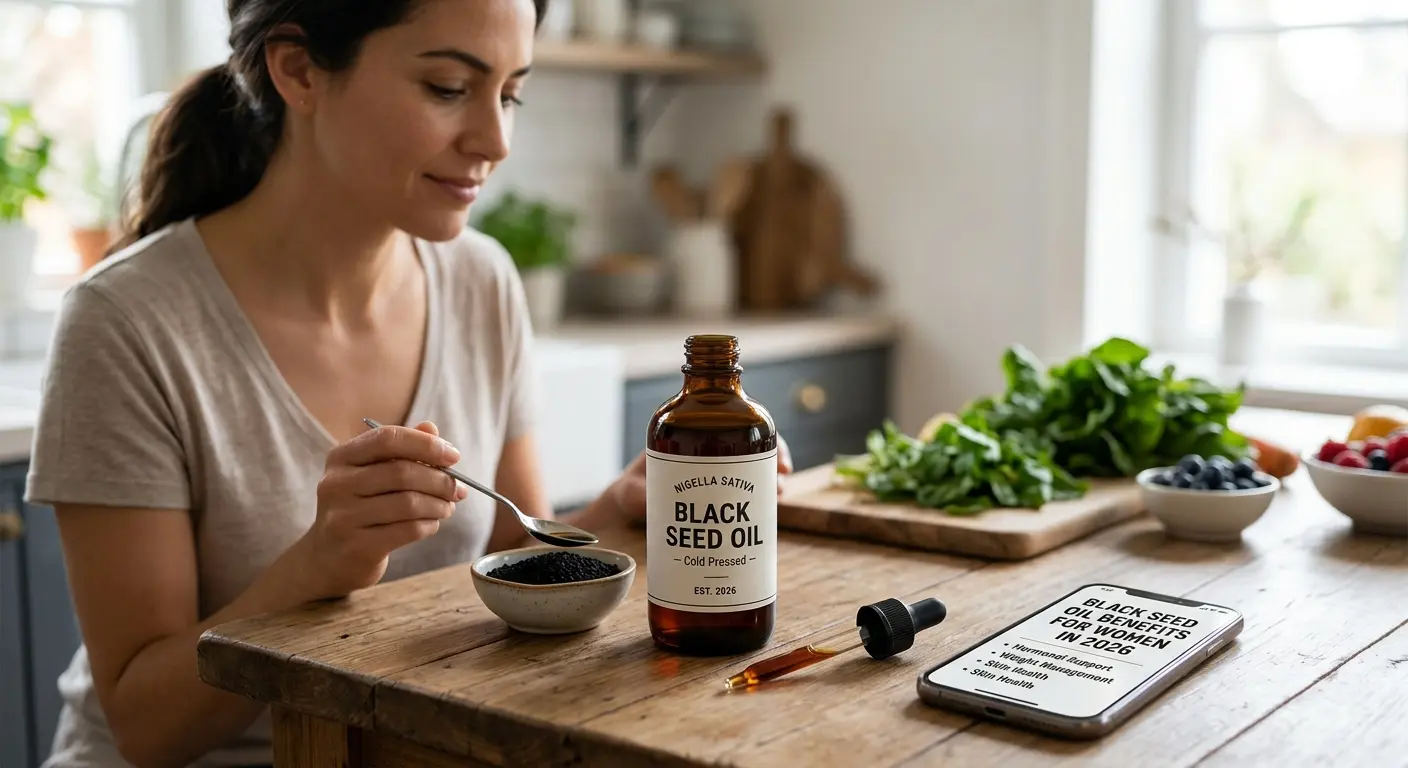
Black seed oil benefits for women include support for blood sugar, cholesterol, weight management, skin, and inflammation, plus newer research on PCOS, PMS, and menopause. The evidence ranges from solid to preliminary depending on the claim, and knowing which is which matters more than any single ingredient list.
Most articles about this natural oil oversell it as a cure for everything. Others skip past the topics that matter most to women, like PCOS, menopause, and whether it is safe with birth control. This guide sticks to what the actual research says, including where that research is thin.
What Is Black Seed Oil?
Black seed oil comes from the seeds of Nigella sativa, a flowering plant related to buttercups that grows across Southwest Asia, North Africa, and the Mediterranean. People also call it black cumin seed oil or kalonji oil, and it has shown up in traditional medicine for more than 2,000 years, including in Ayurvedic and Unani practice.
The compound doing most of the work is thymoquinone. It typically makes up less than 1 percent of the oil, but it drives most of the antioxidant and anti-inflammatory effects researchers have documented. The oil itself is mostly linoleic and oleic acid, the same fats found in sunflower oil and olive oil.
What Are the Benefits of Black Seed Oil for Women?
Research on black seed oil covers a wide range of topics relevant to women’s health. Some of it is solid, backed by meta-analyses of multiple trials. Some of it comes from a single small study that has not been repeated.
The clearest black seed oil benefits for women fall into two groups: metabolic effects like blood sugar, cholesterol, and weight, and hormonal effects tied to PCOS, PMS, and menopause. Here is where the evidence currently stands, organized by topic rather than by hype.
Does Black Seed Oil Help With PCOS?
PCOS is one of the more promising and least talked about uses for black seed oil. In a double blind, placebo controlled trial, 84 women with PCOS who had irregular or absent periods took Nigella sativa oil capsules nightly for 16 weeks. Their menstrual cycles became significantly more regular compared to the placebo group.
That result lines up with black seed oil’s documented effect on insulin sensitivity, since insulin resistance is one of the core drivers of PCOS. This is not a replacement for PCOS treatment, and it is one study, not a body of proof. But it is a genuinely researched connection that most articles on this topic never mention at all.
Can Black Seed Oil Help With PMS and Period Cramps?
A randomized, placebo controlled trial found that black seed reduced the severity of PMS symptoms in women who took it. Researchers tied the effect to changes in estrogen levels during the days before a period, when dropping estrogen is linked to mood swings, fatigue, and cramping.
This is a specific, testable finding, not the vague hormone balance language that shows up in most supplement marketing.
Does Black Seed Oil Help During Menopause?
One randomized controlled trial gave postmenopausal women 910 to 1,365 milligrams of Nigella sativa extract daily and found improvements in estradiol levels and vaginal tissue health. Black seed oil does not contain estrogen itself.
What it appears to do is support the body’s own hormone activity and calm inflammation, which may explain why some women report easier symptoms during the menopause transition.
Does Black Seed Oil Support Thyroid Health?
Hashimoto’s thyroiditis, an autoimmune thyroid condition, affects women far more often than men. In a small trial of 40 people with Hashimoto’s who were already on thyroid medication, adding powdered black seed for 8 weeks modestly reduced thyroid antibodies and TSH compared to placebo.
That is one small study, and it used powder, not oil, so results might not carry over directly. Anyone on thyroid medication should treat this as a conversation to have with a doctor, not a reason to swap out treatment.
Does Black Seed Oil Help With Weight Loss?
Two separate meta analyses looked at controlled trials on black seed oil and weight. Both found that oil, taken at 3,000 to 5,000 milligrams a day for 4 to 6 weeks, led to an average weight loss of about 5 pounds compared to placebo.
Black seed powder told a different story. At doses of 1,000 to 2,000 milligrams, powder did not produce a significant change in body weight. If weight loss is the goal, the oil form has the evidence behind it, not the powder or the seeds themselves.
Is Black Seed Oil Good for Skin and Acne?
A 60 day trial involving 60 people with acne tested a topical gel containing 0.1 percent black seed extract. Compared to placebo, it reduced comedones by 83 percent, papules by 79 percent, and overall acne severity by 78 percent.
Beyond acne, the oil’s linoleic acid and oleic acid content helps skin hold onto moisture. That is why it shows up in serums and body oils marketed for dryness and dullness.
Does Black Seed Oil Help Hair Growth?
This is where the evidence gets thin. Despite how often black seed oil gets marketed for hair growth, there are no well designed clinical trials testing it specifically for that use. Any benefit likely comes from fatty acids and antioxidants supporting a healthier scalp, not a documented hair growth effect. If regrowth is the goal, treat this as a nice to have, not a proven fix.
Does Black Seed Oil Help Blood Sugar, Cholesterol, and Blood Pressure?
A meta analysis of seven trials found that black seed oil or powder modestly lowered fasting blood sugar and HbA1c, the marker doctors use to track blood sugar over several months. A separate review of 17 trials found it lowered total cholesterol, LDL, and triglycerides by roughly 15 milligrams per deciliter each.
Blood pressure worked differently. Only the powder form showed a small but real drop, around 3 to 4 points systolic. The oil form did not show a significant effect on blood pressure at all.
How Much Black Seed Oil Should Women Take?
There is no single official dose, since most research comes from clinical trial protocols rather than formal dose finding studies. Dosing for black seed oil benefits for women breaks down by goal rather than one universal number.
- Weight loss: 3,000 to 5,000 milligrams of oil daily
- Cholesterol support: 1,000 to 3,000 milligrams of oil daily
- Blood pressure: 500 to 2,000 milligrams of powder daily
- General use: 1,000 to 3,000 milligrams daily, oil or capsule form
Most trials lasted only 4 to 12 weeks, so treat any dose beyond that window as unstudied territory. Liquid oil has a strong, bitter taste. Many people find it easier to manage mixed with honey or stirred into food. Capsules skip the taste question entirely, though you may need several to hit higher doses. Start low, and talk to a doctor before committing to a daily routine, especially if you take other medications.
Is Black Seed Oil Safe During Pregnancy and Breastfeeding?
No. Black seed oil is contraindicated during pregnancy because it may slow or stop uterine contractions. There is also not enough safety data to support using it while breastfeeding. Every source reviewed for this article agrees on this point without exception.
Does Black Seed Oil Interact With Medications?
Black seed oil can intensify the effect of diabetes medications, blood pressure drugs, and blood thinners like warfarin or aspirin. That combination raises the risk of low blood sugar, low blood pressure, or excess bleeding.
There is also a documented case of serotonin syndrome in a man who combined black seed oil with anesthesia during surgery, tied to a mild MAO inhibiting effect from thymoquinone. Doctors generally recommend stopping black seed oil at least two weeks before any surgery.
Nigella sativa has shown estrogenic and hormone modulating activity in research. Because of that, it is worth mentioning to a doctor if you are on hormonal birth control or an IUD, even though no direct interaction study exists yet.
How Do You Choose a High Quality Black Seed Oil?
Look for oil that is cold pressed and sold in a dark glass bottle, since light and heat both degrade thymoquinone over time. A quality label will disclose the thymoquinone percentage, ideally close to 3 percent for concentrated products. Once opened, refrigeration helps the oil hold its potency for closer to the full 1 to 2 year shelf life instead of degrading early.
Adulteration is a real, documented problem in this category. Cheaper soybean, palm, or corn oil sometimes gets mixed in to stretch a batch, and most labels never mention it. Because of that, a certification mark from NSF International, USP, or ConsumerLab is worth more than a low price or a pretty label. That mark tells you more about real black seed oil benefits for women than the marketing copy on the front of the bottle does.
Black Seed Oil vs Black Seed Powder: Which Is Better?
They are not interchangeable. Oil has the stronger evidence for weight loss and cholesterol, largely because it retains the fatty acids that seem to drive those effects. Powder has the edge for blood pressure and keeps the fiber and protein that the oil extraction process removes.
If you are choosing based on a specific goal, match the form to the benefit rather than assuming one is simply the stronger version of the other.
Conclusion
Black seed oil is not a miracle fix, and treating it like one is exactly what makes so much of the existing content hard to trust. What it does have is a real, if modest, research base covering blood sugar, cholesterol, weight, skin, and increasingly, PCOS, PMS, and menopause.
Start with a clear goal, pick the form the evidence actually supports for that goal, and loop in a doctor if you take other medications or are pregnant or breastfeeding. That is how black seed oil benefits for women translate from a research summary into something you can actually use.
FAQs
Does black seed oil interact with birth control?
There is no direct study on this combination, but black seed oil has shown estrogenic and hormone modulating effects in research. Mention it to your doctor if you use hormonal birth control or an IUD.
Can black seed oil cause serotonin syndrome?
It is rare, but a documented case involved a man who combined black seed oil with anesthesia during surgery. Stop taking it at least two weeks before any procedure to be safe.
What is the difference between black seed oil and thymoquinone extract?
Standard black seed oil contains around 0.5 percent thymoquinone along with a full fatty acid profile. Concentrated extracts isolate thymoquinone up to 20 percent but strip out most of the omega fatty acids.
Is black seed oil safe to take every day?
Most clinical trials used daily doses for 4 to 12 weeks with only mild side effects like nausea or bloating. Safety data beyond about 6 months does not exist yet, so daily use short term is reasonably supported, long term is not.