
Bad Urach Waterfall: Complete Hiking Guide, Costs, and Best Time to Visit
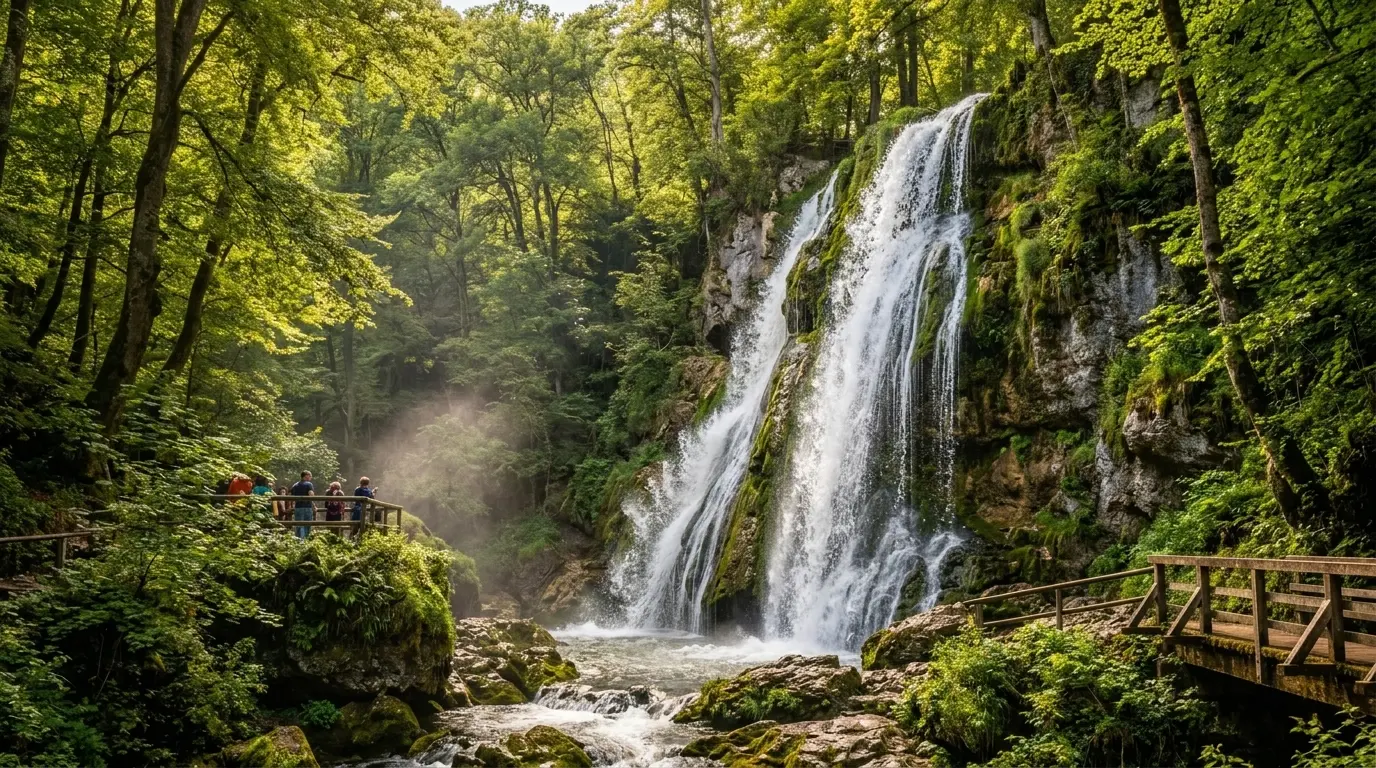
The Bad Urach waterfall is a free, 37 meter cascade in Germany‘s Swabian Alb, reachable in about 30 minutes from Stuttgart by car or train. A flat 2 kilometer path leads most visitors to the base, while a steeper stair climb and a longer loop hike reward those who want more.
That range of options is exactly what makes this spot tricky to plan around. Some guides make it sound like a quick stroll, others describe a half day hike, and the truth depends entirely on how much of the trail you want to cover. Here’s what actually happens once you arrive.
What Is the Bad Urach Waterfall?
The Bad Urach waterfall, known locally as the Uracher Wasserfall, drops 37 meters through the Swabian Alb Biosphere Reserve near Stuttgart. Water from the Brühlbach stream flows over travertine rock, a porous limestone formation that keeps growing as mineral rich karst spring water deposits lime onto the moss below.
That growing rock is part of why the site holds protected status as a geotope and forest biotope. Stepping into the waterfall area itself is discouraged for this reason, even though the water looks inviting on a hot day.
How Do You Get to Bad Urach Waterfall From Stuttgart?
Drivers should take the A8 motorway toward the Wendlingen exit, then follow the B313 and B465 into Bad Urach, a drive of roughly 30 minutes. Signs inside town point the way to the P23 parking lot in the Maisental valley, which sits right at the start of the trail.
Public transport works just as well here, and it’s underrated compared to how most guides frame it. The regional train stops directly at Bad Urach Wasserfall, served regularly from Metzingen and Reutlingen. From that stop, it’s about a 30 minute walk to the Maisental valley, or a short hop on the local bus if you’d rather skip the walk.
Is There an Entrance Fee for Bad Urach Waterfall?
There is no entrance fee to walk the trail or see the waterfall. The only real cost is parking at P23, which runs a flat rate around 5 euros, charged during set daytime hours, usually 9am to 5pm or 6pm depending on the lot.
Outside those hours, parking is free. A separate free lot also exists near the train stop, just after the tracks on the right side coming from Stuttgart, though it fills up fast on sunny weekends. Card payment, including contactless, is accepted at most machines now, so bringing exact change is no longer the necessity older guides suggest.
| Item | Cost |
| Trail access and waterfall viewing | Free |
| P23 parking (daytime) | Around 5 euros |
| P23 parking (before 9am or after 5pm) | Free |
| Free lot near train stop | Free, limited spaces |
| Train ticket from Stuttgart | Varies by rail pass |
How Long Is the Hike to Bad Urach Waterfall?
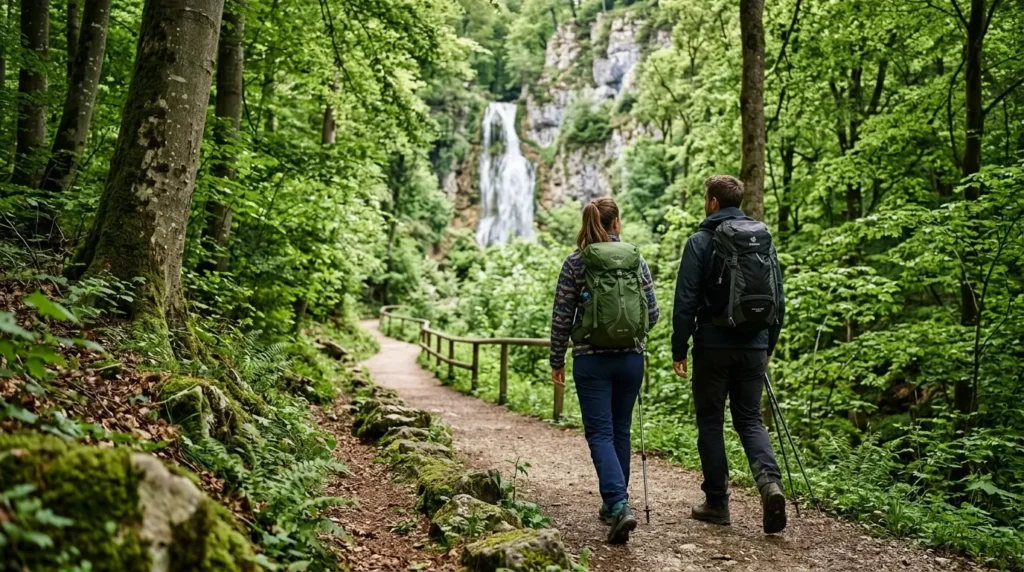
The flat path from P23 to the base of the waterfall covers about 2 kilometers, which takes most people 30 to 40 minutes each way at an easy pace. That section runs on wide, well packed gravel alongside the Brühlbach stream and stays mostly level the entire way.
Climbing higher changes the picture completely. The stairs beside the falls add a steep 600 meter stretch to reach the high meadow, and hikers who continue the full Wasserfallsteig loop out to the Güterstein waterfall and back cover anywhere from 6.7 to 10 kilometers depending on the route chosen.
| Route | Distance | Time |
| Flat walk to waterfall base | 2 km one way | 30 to 40 minutes |
| Base plus stair climb to meadow | 2.6 km one way | 1 to 1.5 hours |
| Full Wasserfallsteig loop | 6.7 to 10 km | 3 to 3.5 hours |
What’s the Difference Between the Urach Waterfall and the Güterstein Waterfall?
The Urach waterfall is the main event, a dramatic 37 meter drop close to the trailhead that draws nearly all day visitors, since it’s the only stop for anyone doing the short flat walk. Most people never go further than this point, and that’s completely fine if a quick nature stop is all you’re after.
The Güterstein waterfall sits much further along the loop, past Rohrauer Hütte, and has a different character entirely. Cascading water falls in smaller tiers into a pool, giving it a quieter, more secluded feel that many hikers who complete the full loop actually prefer over the bigger, busier Urach falls.
How Difficult Is the Hike Up the Stairs at Bad Urach Waterfall?
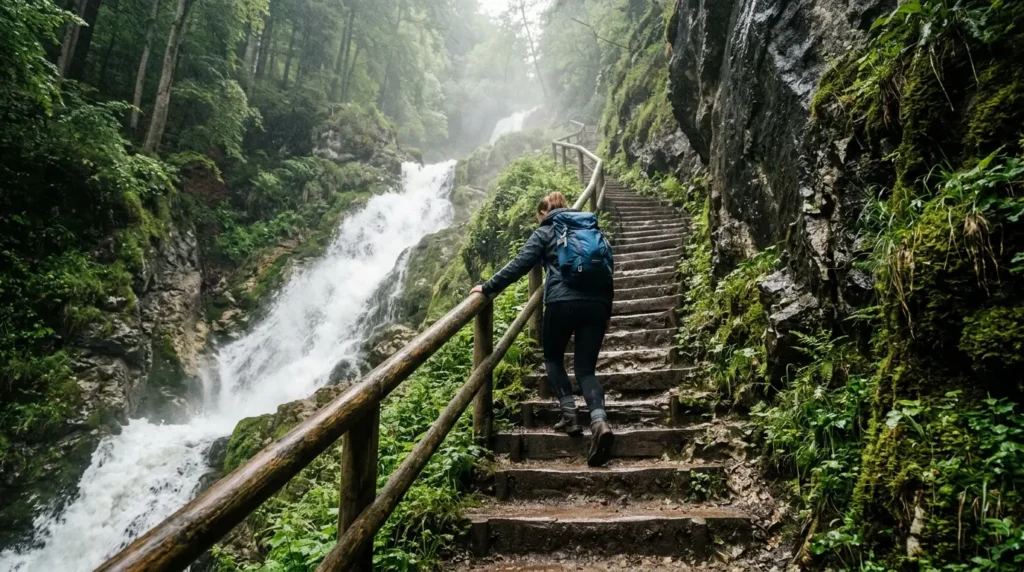
The stair section next to the waterfall is steep and demands real attention. Roughly 200 steps climb alongside the cascade, and sections lack handrails, which catches some visitors off guard after the easy flat walk that comes before it.
Wet conditions make this section genuinely risky. The chalky limestone rock gets slick fast, whether from rain, waterfall spray, or winter ice, and a common mistake first timers make is wearing flip flops or smooth soled shoes because the approach path felt so easy. Grippy hiking shoes or trail runners make a real difference here, and hiking poles help too if you’re doing the full loop with the elevation gain that follows.
Is the Bad Urach Waterfall Trail Stroller Friendly?
The first 2 kilometers from P23 to the waterfall base work well for strollers and wheelchairs with sturdy wheels, since the surface stays flat and firmly packed the whole way. Families with young kids and travelers using mobility aids can comfortably reach the falls without issue on this stretch.
The stairs beyond the base are a different story entirely. There’s no stroller or wheelchair access past this point, and the climb requires full mobility and secure footing, so anyone planning to bring a stroller should treat the base of the waterfall as the natural turnaround point.
When Is the Best Time to Visit Bad Urach Waterfall?
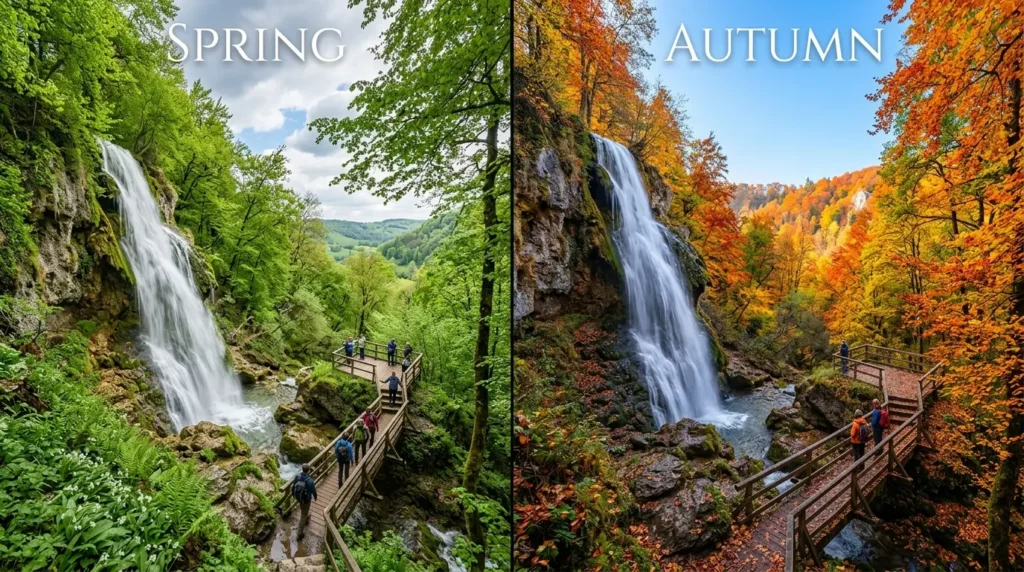
Timing your visit around recent rainfall makes the single biggest difference in how impressive the waterfall looks. Flow rates swing widely, from as little as 70 liters per second during dry stretches to as much as 420 liters per second after heavy rain or spring snowmelt, and that gap is the difference between a modest trickle and a genuinely powerful cascade.
Travelers consistently find that spring, right after snowmelt, or any period following a few days of rain delivers the most dramatic version of the waterfall. Late summer dry spells, by contrast, sometimes leave visitors disappointed by a thinner flow than photos led them to expect.
Crowds follow a predictable pattern too. Arriving before 10am, especially on weekdays, means quiet trails and clear photos without other hikers in the frame. By late morning on a sunny weekend, the parking lots fill and the stairs near the falls get genuinely busy with people stopping constantly for photos.
When Is the Wasserfallhütte Open?
The Wasserfallhütte, the hut perched on the high meadow above the waterfall, typically operates from March through November and closes for the winter months. Visitors hiking in December, January, or February should expect it closed, with the door often simply stating the reopening month.
Rohrauer Hütte further along the loop follows a similar seasonal rhythm, serving food and drinks mainly through the warmer months. Anyone hiking outside March to November should pack their own snacks and water, since relying on either hut for a mid hike refuel isn’t a safe bet in the off season.
Does Bad Urach Waterfall Freeze in Winter?
The waterfall rarely freezes solid, since the flow from the karst spring keeps moving even in cold snaps, but sustained freezing temperatures do create striking ice formations along the rock face and edges. Winter visits reward hikers with a genuinely different look at the same landmark, and trails stay open year round with no seasonal closure.
The tradeoff is footing. Ice on the stairs and chalky rock makes the climb noticeably more hazardous than in warmer months, so waterproof, slip resistant boots aren’t optional if you’re visiting between December and February.
Is Bad Urach Waterfall Dog Friendly?
Dogs are welcome throughout the trail and the full loop hike, as long as they stay leashed. The Brühlbach stream running alongside the flat approach path gives dogs a natural spot to cool off on a hot day, and it’s a common sight to see dogs wading in in summer.
What Else Is There to Do Near Bad Urach Waterfall?
Bad Urach offers plenty beyond the waterfall itself, which is part of why many travelers turn this into a full day rather than a quick stop.
- Hohenurach castle ruins, reachable by continuing past the falls to the top of the trail, with panoramic views over the valley
- AlbThermen, the town’s thermal spa, drawing on natural hot spring water
- Lichtenstein Castle, about 30 minutes south, known for dramatic clifftop architecture and a ropes course
- Bad Urach’s half timbered old town, with its historic Royal Palace and cobbled streets
- Metzingen Outletcity, a well known outlet shopping destination nearby
Can You Combine Bad Urach Waterfall With the AlbThermen Spa in One Day?
Yes, and it’s a genuinely natural pairing once you know the town’s history. Bad literally translates to bath in German, and Bad Urach earned that name from mineral water discovered at 770 meters depth back in 1970, after local citizens formed a drilling group in 1969 specifically to find it.
AlbThermen now channels that thermal water into six indoor and outdoor pools, heated between 32 and 38 degrees Celsius, along with a sauna area. After a few hours on the Wasserfallsteig, particularly if you’ve tackled the stairs and the elevation gain of the full loop, soaking in warm mineral water is a genuinely satisfying way to end the day rather than just a bonus stop.
Is Bad Urach Waterfall Worth Visiting?
For a free attraction less than an hour from Stuttgart, Bad Urach waterfall delivers far more range than its size suggests. Families get a flat, stroller friendly walk to a genuinely impressive 37 meter cascade, while serious hikers get a challenging full day loop with a second waterfall, castle ruins, and real elevation gain.
The honest downside worth knowing before you go is that dry weather can leave the falls underwhelming, and the stairs demand proper footwear and caution regardless of season. Plan around recent rainfall, arrive early if you want quiet trails, and the Bad Urach waterfall earns its reputation as one of the best short nature trips out of Stuttgart.
Final Thoughts
Bad Urach waterfall works whether you have thirty minutes or a full day to spare. Check recent rainfall before you go, wear real hiking shoes if you’re tackling the stairs, and time your arrival before mid morning if crowds bother you. Pair it with AlbThermen afterward and you’ve got one of the most complete half day trips within easy reach of Stuttgart.
FAQs
How do I get to Bad Urach waterfall from Stuttgart?
Drive the A8 to the Wendlingen exit then follow the B313 and B465, about 30 minutes total, or take the regional train directly to the Bad Urach Wasserfall stop.
Is there an entrance fee for Bad Urach waterfall?
No, the trail and waterfall are free. Only parking at P23 costs money, around 5 euros during daytime hours.
How long is the hike to Bad Urach waterfall?
The flat walk to the base takes 30 to 40 minutes each way. The full Wasserfallsteig loop runs 3 to 3.5 hours.
Is the Bad Urach waterfall trail stroller friendly?
Yes, up to the base of the waterfall. The stairs beyond that point are not stroller or wheelchair accessible.
What’s the best time of year to see Bad Urach waterfall?
Spring after snowmelt or any period following recent rain gives the strongest flow. Dry summer stretches can leave it thin.
Is Bad Urach waterfall dog friendly?
Yes, leashed dogs are welcome on the full trail and loop hike.
Can you take a train to Bad Urach waterfall?
Yes, the regional line stops directly at Bad Urach Wasserfall station, a short walk from the trailhead.
Does Bad Urach waterfall freeze in winter?
It rarely freezes solid, but cold spells create ice formations on the rock, making the stairs more slippery.


