
Saint Martin vs Sint Maarten: Which Side Should You Visit in 2026?
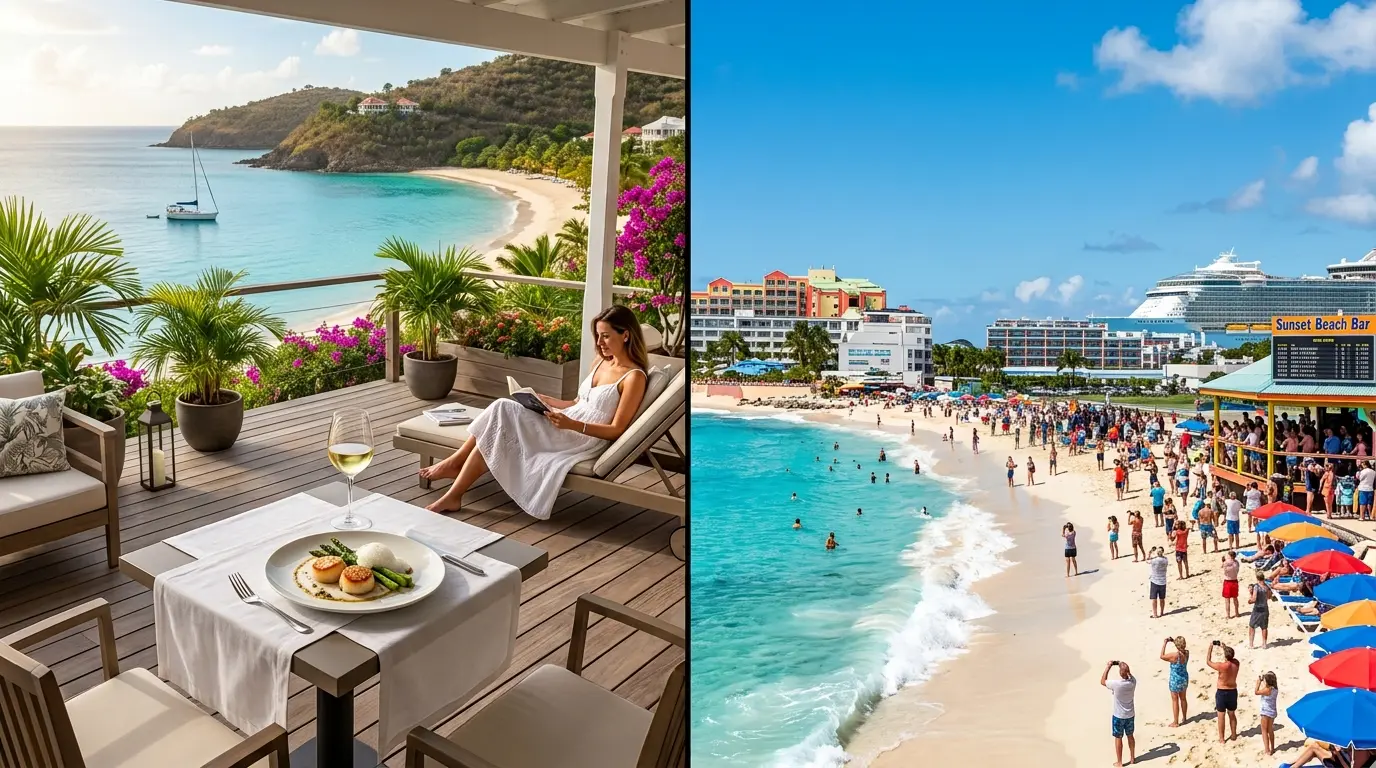
Saint Martin is the French north and Sint Maarten is the Dutch south of the same 37-square-mile Caribbean island. Saint Martin offers boutique hotels, world-class French cuisine, and secluded beaches. Sint Maarten delivers casinos, duty-free shopping, and electric nightlife. You can cross between both sides freely with zero border control, no passport check, and no delay.
Most first-time visitors search this island using the wrong spelling or assume these are two separate places. They are the same island, split between two countries, two currencies, and two completely different personalities. This guide answers every question so you can decide where to base yourself.
What Is the Difference Between Saint Martin and Sint Maarten?
Saint Martin (north) is an overseas collectivity of France. Sint Maarten (south) is a constituent country within the Kingdom of the Netherlands. The island split in 1648 under the Treaty of Concordia, making this border the oldest continuously open border in the world. According to local legend, a wine-drinking Frenchman and a beer-drinking Dutchman walked in opposite directions from one starting point. The Frenchman walked farther, giving France the larger share: 21 square miles in the north versus 16 square miles in the south for the Netherlands.
The Concordia Monument on the road between Cole Bay and Marigot marks where one country ends and the other begins. You drive straight past it with no stop. Road signs shift from English and Dutch in the south to French in the north. That shift in language on the road signs is often the only signal you have crossed.
The island holds over 100 nationalities and more than 80 languages spoken among its residents. It carries the nickname the Friendly Island for the warmth of its people on both sides, and every year that reputation holds up.
Which Side Should You Choose? The Fast Decision Guide
Here is the fastest way to understand the saint martin vs sint maarten comparison:
- Saint Martin (French side): Best for couples, honeymooners, foodies, and slow travelers who want boutique hotels and secluded coves.
- Sint Maarten (Dutch side): Best for families, nightlife seekers, cruise passengers, duty-free shoppers, and casino lovers.
Most visitors with five or more days end up exploring both. The island is small enough to have lunch in Grand Case on the French side and be back at your Dutch-side hotel before dinner. The open border makes that easy.
Which Side Has Better Beaches?
The French side edges ahead on beaches. Saint Martin holds Orient Bay, Friar’s Bay, Happy Bay, Baie Rouge, Anse Marcel, and Baie Longue among its best stretches. These range from vibrant beach clubs to empty coves accessible only on foot. The Réserve Naturelle Nationale de Saint-Martin protects the marine environment around Creole Rock near Grand Case, keeping snorkeling conditions strong.
Sint Maarten delivers Mullet Bay Beach, one of the most beautiful single beaches on the Dutch side: wide white sand, clear turquoise water, and a golf course backdrop. Cupecoy Beach offers dramatic limestone cliffs good for sunset watching. Great Bay Beach runs directly through Philipsburg with cruise ships anchored in the distance.
Key things to know about Orient Bay:
- The main stretch is family-friendly with beach clubs, watersports, and restaurants.
- The far southern end near the former Club Orient nudist resort site is clothing-optional only. The rest of the beach is fully standard.
- Friar’s Bay connects via a 15-minute foot trail to Happy Bay, which has near-zero crowds and zero facilities.
- Pinel Island is five minutes by ferry from Cul-de-Sac with shallow calm water, resident iguanas, and two beach restaurants.
Which Side Wins for Food?
Saint Martin takes this category without contest. The island carries the title of culinary capital of the Caribbean, and Grand Case is the proof.
Grand Case is a small beachfront village whose main road, Boulevard de Grand Case, packs outstanding restaurants end-to-end in what travelers call Restaurant Row. Le Pressoir serves inventive French-Caribbean cuisine. L’Auberge Gourmande goes deep on French classics including escargots and foie gras. Bistrot Caraïbes keeps live lobsters in a tank so you pick yours before they cook it.
Between those fine dining spots sit the lolos. A lolo is a locally owned open-air food stall where full plates of jerk chicken, grilled lobster, rice and peas, and johnny cakes run between $10 and $20. The food at a good lolo rivals many sit-down restaurants nearby. Talk of the Town and Sky’s the Limit are consistently recommended. On Tuesday evenings in high season, Mardis de Grand Case shuts the road to traffic and turns the entire village into a street festival.
Sint Maarten handles variety better than excellence. Moulin Fou in Maho Beach delivers the best French cooking on the Dutch side. Bamboo House covers sushi and cocktails. The Greenhouse in Philipsburg handles American-Caribbean comfort food reliably. Every November, St. Maarten Flavors Culinary Month runs special menus across the island’s top restaurants.
If food drives your travel decisions, stay on the French side. If variety over excellence matters more, the Dutch side satisfies.
Which Side Has Better Hotels?
The French side leads for boutique character. Hotel L’Esplanade in Grand Case offers suites with full kitchens, ocean views, and an infinity pool in a quiet garden above the village. Le Petit Hotel sits directly on Grand Case Beach with ten rooms and service that no large resort can replicate. Belmond La Samanna on Baie Longue is the island’s most exclusive property, starting at $700 per night in peak season.
The Dutch side leads for large resorts and family options. Sonesta Ocean Point Resort is the best adults-only all-inclusive on Sint Maarten, with swim-out suites and butler service. Sonesta Maho Beach Resort handles families with a full kids’ club and all-inclusive packaging. Oyster Bay Beach Resort gives all 180 suites a direct water view between Oyster Pond and the Atlantic. Holland House Beach Hotel positions you on the Philipsburg boardwalk within steps of duty-free Front Street.
One practical note: if you plan to use Hilton or Marriott hotel loyalty points, the Dutch side is your only realistic option. French-side boutique properties are almost entirely independent.
Which Side Has Better Nightlife?
Sint Maarten wins this comparison without any real competition.
The Dutch side runs more than 20 casinos. Casino Royale in Maho is the largest, with table games, poker, slots, and regular shows. Mykonos SXM runs an outdoor pool party with DJs until 3am. Red Piano Lounge offers live music seven nights a week and a liquor shelf of over 300 spirits. Bar Bamboo hosts themed DJ and live music events from 6pm to 2am every night. Soggy Dollar Bar draws the sailing crowd from Simpson Bay Lagoon into a waterfront open-air tropical setting.
The French side offers a completely different pace after dark. Long wine dinners in Grand Case, live music at Captain Frenchy on Friday and Saturday nights, and late cocktails at Quai 58 until 1am. If you need clubs and dancing, you go Dutch. If you want a bottle of Burgundy with grilled lobster on a quiet beach, you go French.
Which Side Has Better Activities?
Sint Maarten dominates for adrenaline. Rainforest Adventure Park runs the Flying Dutchman, the world’s steepest zipline, dropping more than 1,000 feet across 2,800 feet of cable from Sentry Hill. Views at the top stretch to Anguilla, St. Barts, and Saba. Maho Beach is where KLM jets from Amsterdam and Air France planes from Paris land directly over beach chairs. The departing jet blast is physically dangerous: stay well back from the fence when planes push back. Sunset Beach Bar posts the daily arrival board.
The Dutch side also offers America’s Cup Sailboat racing experiences from Simpson Bay, wreck diving at Man of War Shoal Marine Park, and the world-famous Heineken Regatta every March.
The French side excels for nature and culture. Hiking Pic Paradis at 424 meters through the rainforest at Loterie Farm delivers panoramic views across the entire island. Catamaran day trips to Tintamarre Island give you snorkeling with sea turtles inside the marine reserve. You can also create a custom signature scent at Tijon Perfumery in Marigot, taste rum at Topper’s Rhum Distillery on the Dutch side, or explore the Guavaberry Emporium on Front Street in Philipsburg for the island’s national spirit.
Currency, Getting Around, and Practical Logistics in 2026
Saint Martin uses the Euro (EUR). Sint Maarten officially uses the Netherlands Antillean Guilder (ANG), pegged to the dollar at 1.8 to 1. US dollars work practically everywhere on both sides in tourist zones, making them the most useful currency to carry. Credit cards work widely. The French side runs more expensive overall, particularly for dining and hotels.
All international visitors fly into Princess Juliana International Airport (SXM) on the Dutch side. KLM flies direct from Amsterdam. Air France flies direct from Paris. American, Delta, JetBlue, and United serve major US cities with flight times of 3 to 4 hours from the East Coast. The Grand Case L’Espérance Airport (SFG) on the French side handles small inter-island flights via Winair to Guadeloupe, Martinique, and St. Barts.
Rental cars give the most freedom for $30 to $60 per day through agencies at the airport. Public minibuses run the Philipsburg to Marigot route for $2 to $3 per ride. Taxis charge government-regulated fares by zone. Uber and Lyft do not operate on this island as of 2026.
For day trips, Anguilla is a 20-minute ferry from Marigot. St. Barts is 45 minutes via Voyager or Great Bay Express ferry. Saba is 90 minutes by ferry from Philipsburg or 12 minutes on a Winair Twin Otter. All three trips require a valid passport.
What You Should Know About Hurricane Irma Recovery in 2026
Hurricane Irma hit the island in September 2017 and the two sides recovered at very different speeds.
The Dutch government funded rebuilding faster and more heavily. Sint Maarten’s resorts, commercial zones, and Philipsburg are largely restored. The French side received slower and smaller government investment. In 2026, visible hurricane damage remains in Sandy Ground, Baie Nettlé, and on some approach roads into Grand Case. The Butterfly Farm at Orient Bay has not reopened since 2017. Club Orient nudist resort is still in the process of rebuilding.
However, most French-side hotels and restaurants completed full renovations and are excellent. A few damaged buildings on entry roads should not change your decision about staying on the French side. The dining and beach experience there remains world-class.
Final Thoughts
The saint martin vs sint maarten comparison comes down to one core question: do you want refinement or energy? French side for food, romance, boutique hotels, and quiet coves. Dutch side for casinos, nightlife, shopping, and large resort options. The open border means you never have to fully commit to one side. Most visitors use both: sleep on one side and spend their days on the other. Book early for December through April, carry US dollars for both territories, and respect the French pace when you cross north. You will leave this island already researching when to return.
FAQs
Is there border control between Saint Martin and Sint Maarten?
No. The border is fully open. You drive across with no passport check, no customs stop, and no delay. The Concordia Monument near Cole Bay and Marigot is the only visible marker.
Which airport serves both sides of the island?
Princess Juliana International Airport (SXM) on the Dutch side handles all international flights. Grand Case L’Espérance Airport (SFG) covers small inter-island flights to Guadeloupe, Martinique, and St. Barts only.
What currency should I bring?
US dollars work on both sides in tourist areas. The French side officially uses Euro and the Dutch side uses the Netherlands Antillean Guilder, but most restaurants, hotels, and shops accept dollars in both territories.
Is English spoken on the French side?
In tourist-facing restaurants, hotels, and shops, yes. In local markets and smaller neighborhood businesses, French dominates. Knowing “bonjour” and “merci” helps and locals appreciate the effort.
What is a lolo in Saint Martin?
A lolo is a locally owned open-air food stall serving Caribbean BBQ. Full plates of jerk chicken, grilled lobster, and johnny cakes cost between $10 and $20. The best lolos line Grand Case Boulevard.
What is guavaberry rum?
Guavaberry rum is Sint Maarten’s national drink, a spiced liqueur made from local guavaberries with roots in the island’s holiday tradition. The Guavaberry Emporium on Front Street in Philipsburg offers free tastings. It appears in Guavaberry Coladas at bars across the island.
Is Sint Maarten good for a cruise stop?
Yes. The A.C. Wathey Pier in Philipsburg docks up to six ships at once. Front Street duty-free shopping runs within walking distance of the pier. Sint Maarten earned the No. 1 Caribbean Cruise Port award from Cruise Critic.
When is the best time to visit?
The dry season from December through April offers the most reliable weather. The Heineken Regatta in March and Mardis de Grand Case on Tuesday evenings in high season are worth building your timing around. Avoid August through October for hurricane risk.
Do you need a visa to visit Sint Maarten or Saint Martin?
US, Canadian, and EU citizens receive visa-free tourist entry on both sides. A valid passport is required for initial entry. Once you have legally entered either side, you cross to the other without additional checks.


