
Traveling in Albania: The Complete 2026 Guide
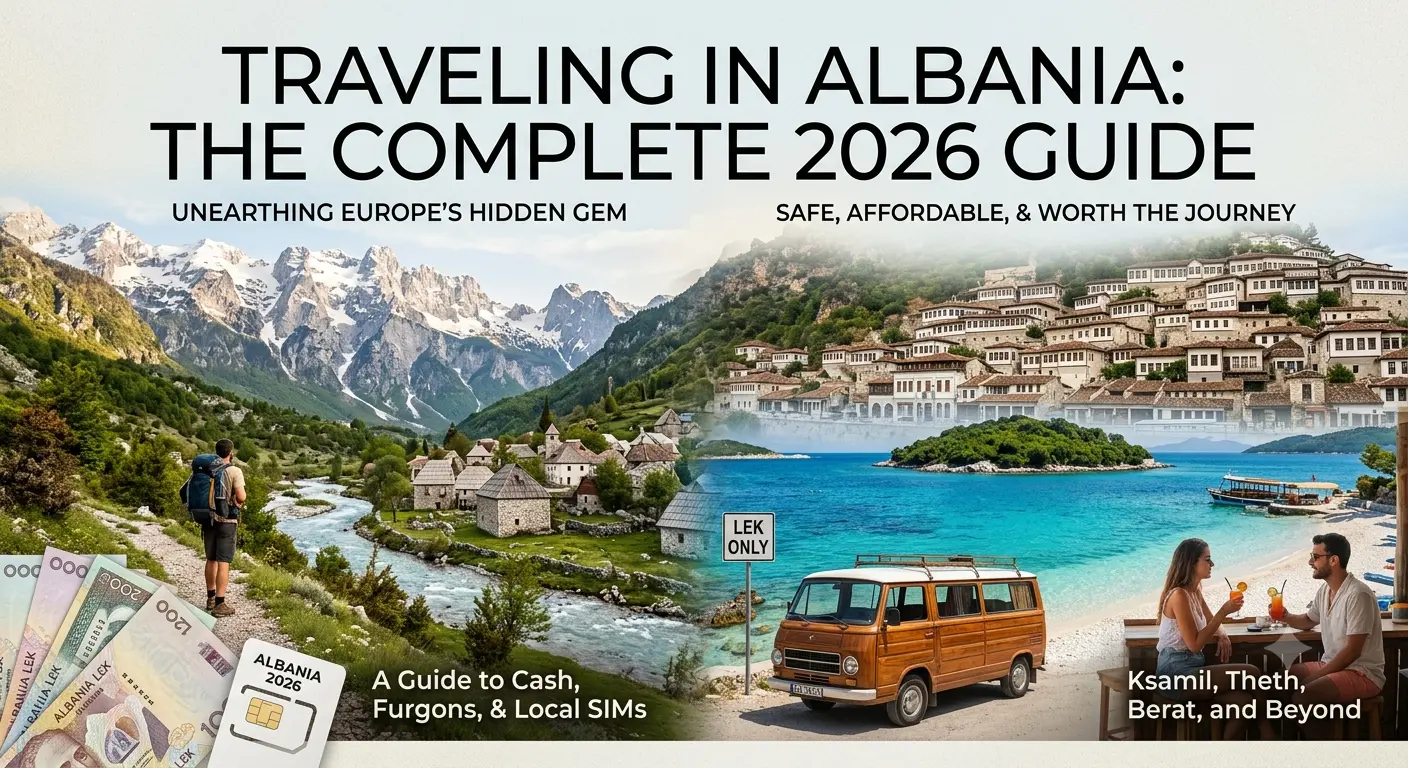
Traveling in Albania means beach towns on the Riviera, UNESCO towns like Berat and Gjirokaster, hiking in the Alps, and a cash based economy that still runs on its own currency. It is one of the cheapest countries left in Europe, though buses run on their own schedule and cell service drops the second you land, so a little planning goes a long way.
Is Albania Worth Visiting?
Yes. Despite its reputation from the movie Taken, Albania is safe, affordable, and offers UNESCO towns, a dramatic coastline, and real mountain hiking, all at prices well below Greece or Croatia. It suits backpackers and flexible travelers more than anyone wanting polished resort infrastructure from the moment they land.
Comparisons to the Maldives or Thailand show up constantly online, and they are mostly marketing. Ksamil is genuinely beautiful but also crowded with lounge chairs and inflated prices in summer, and the glacial rivers in the Alps look tropical in photos but feel closer to an ice bath than a warm sea.
What Language Do They Speak in Albania, and Is It Safe?
Albanian is unrelated to any other living language, similar in isolation to Basque, so a few words like faleminderit for thank you go a long way. English coverage is inconsistent outside Tirana and the main tourist towns, and Italian or Greek often work as a backup thanks to historical ties.
Safety worries usually trace back to the film Taken rather than reality. Most visitors report feeling safe walking at night in Tirana and coastal towns, though aggressive driving and rough road conditions are real hazards worth taking seriously, especially outside major highways.
Is Albania in the EU, and What Currency Does It Use?
Albania is not in the Eurozone, the Schengen area, or the European Union, though it has been an official EU candidate since 2014 with membership potentially possible by 2030. The lek is the official currency and cannot be bought outside Albania, so plan to spend or exchange it all before leaving since nobody abroad will take it back.
Euros are widely accepted in cash, but the exchange rate used at the counter is not always the best one available, so paying in lek usually stretches a budget further.
How Much Does a Trip to Albania Cost?
Expect to pay around 40 to 60 US dollars a day on a backpacker budget covering hostel beds, cheap meals, and local buses, while a comfortable mid range trip with hotels and a few paid tours runs closer to 80 to 120 dollars a day. Coastal resort towns during peak summer push both ranges higher.
A few real prices help fill out the picture:
| Item | Typical Price |
| Restaurant meal | 7 to 10 euros |
| Cocktail | Around 7 euros |
| Hostel bed | From 18 dollars |
| Bunk’Art 2 with audioguide | 700 lek, about 7 euros |
| Butrint entry | 1,000 lek, about 10 euros |
| Tirana to Berat bus | 500 lek, about 5 euros, 2 hours |
A common mistake first timers make is assuming card payment works everywhere. Locals recommend carrying enough cash for at least two days at all times, since many restaurants, museums, and taxis outside Tirana still only take lek in hand.
What Is the Best Time to Visit Albania?
Travelers consistently find that late May through June and September through early October deliver the best balance. High season in July and August brings the warmest sea temperatures but also the biggest crowds and highest prices, especially along the Riviera towns of Himara, Saranda, and Ksamil.
Is Ksamil worth visiting despite the hype? It depends on expectations. The beaches are genuinely striking, but heavy commercialization and lounge chair coverage push at least one experienced traveler to rank it outside their own top ten Albania destinations.
How Do You Get Around Albania Without a Car?
Public transport relies on furgons, which are shared minibuses, and long distance coach buses, with no central bus stations in most cities and published schedules that function more as suggestions than guarantees. A trip quoted at four hours can easily take five, so building in extra time for any bus dependent itinerary matters more than the schedule itself.
There is no Uber or Bolt anywhere in Albania as of 2026, and city taxis usually expect cash. A newer local app called Patoko has started appearing in Tirana and Durres, offering the first real ride hailing option most existing guides have not caught up to yet.
Renting a car costs more but buys real flexibility, particularly for reaching Berat, Gjirokaster, and the Riviera towns on your own schedule. Road infrastructure stays solid on major highways but turns rough and occasionally unpaved once you leave them.
Will Your Phone Work in Albania?
Not automatically. EU roaming does not extend to Albania, so a phone plan that works fine in Italy or Greece will still leave you without data the moment you land. Most travelers buy a local eSIM in advance or grab a physical SIM at Tirana airport, though the airport line can run long since every arriving flight has the same idea.
Downloading offline maps before departure is worth doing regardless of your data plan, since signal drops out completely in parts of the mountains around Theth and Valbona.
Where Should You Go in Albania?
Most itineraries combine three regions: Tirana for culture and communist era history, the Albanian Riviera towns of Himara, Saranda, Dhermi, and Ksamil for beaches, and the Albanian Alps around Theth and Valbona for hiking. Travelers with extra time often add Permet in the south, home to the newer Vjosa Wild River National Park and a growing rafting and hot springs scene that still sees a fraction of the Riviera’s crowds.
Berat, nicknamed the city of a thousand windows for its stacked Ottoman era homes, and Gjirokaster, known as the stone city, are Albania’s two UNESCO World Heritage towns. Butrint National Archaeological Park, with ruins spanning Greek, Roman, Byzantine, and Venetian periods, carries UNESCO status too.
What Is the Theth to Valbona Hike Really Like?
The Theth to Valbona trail, part of the wider Peaks of the Balkans network, runs as a one way, full day hike between the two mountain villages. Most planning guides only describe the full through hike, which requires dropping the bulk of your luggage in Shkoder beforehand and picking a fixed direction to travel.
Fewer sources mention that an easier out and back version exists for travelers who want a taste of the trail without the full logistics. Hiking partway up from either village and returning the same day skips the luggage drop entirely, though you miss the boat crossing on Komani Lake that most one way hikers build their route around.
Is Albania Becoming Overtouristed?
Yes, and the pace is accelerating. Visitor numbers rose from 3.6 million in 2014 to 6.4 million in 2019, then to 7.5 million by 2022, a trajectory several experienced travelers compare directly to Croatia’s own overtourism history a decade earlier. For comparison, Greece welcomed close to 30 million visitors in the same year, but with decades more infrastructure to absorb it.
Ksamil already shows the clearest signs of that pressure, with private beach clubs, jet ski clusters, and prices that surprise budget travelers expecting Albania rates. Inland and northern regions including Pogradec, Lake Ohrid, and mountain villages like Lepushe remain far quieter while that infrastructure catches up, and a growing number of sustainability focused tour operators now build entire itineraries around those slower regions instead of the coast.
Is Albanian Food Good?
Opinions genuinely split here, and worth vs skip depends on what you order. More than one experienced traveler calls the cuisine hit or miss, pointing to salty or slightly off tasting cheese and repetitive meat stews as the low points.
The high points are specific and worth seeking out. Byrek, a flaky pastry stuffed with cheese or spinach, delivers reliably everywhere, and kofte, herbed meatballs grilled over open flame, rarely disappoint either. Seafood along the coast in Saranda and Himara tends to outperform meat dishes inland, tave kosi, baked lamb or chicken in yogurt, is worth ordering at least once, and rakia, a strong grape based liquor flavored with aniseed, shows up as the answer to every occasion whether you are celebrating or just being polite.
Is Tap Water Safe to Drink in Albania, and Is It Cheap?
Tap water is not considered safe to drink in most of the country, so pack a filtered water bottle or plan to buy bottled water throughout the trip, though brushing your teeth with it is generally fine.
Traveling in Albania remains genuinely cheap by European standards, especially next to Greece or Croatia, though prices have climbed noticeably over the past decade. Popular coastal spots like Ksamil now carry elevated pricing that catches budget focused travelers off guard.
Final Thoughts
Traveling in Albania rewards travelers who plan around cash, patience, and realistic timing rather than expecting Western European infrastructure. The coastline and mountains genuinely earn the hype building around them, but the buses, the currency, and the food all come with real tradeoffs worth knowing before you land. Visit in shoulder season, carry more lek than feels necessary, and Albania delivers one of the best value trips left in Europe.
FAQs
Do you need a visa for Albania?
Most visitors from the US, UK, and EU can enter visa free for tourism, as long as their passport stays valid for at least three months from arrival.
How many days do you need in Albania?
Ten to fourteen days covers Tirana, the coast, and the Alps without rushing, though a focused one week trip still works well for a single region.
Is Albania part of the Balkans?
Yes, Albania sits in the Balkans in Southern Europe, bordering Greece, Kosovo, North Macedonia, and Montenegro.
What is the exchange rate for Albanian lek?
Rates shift, but a rough guide has been about 90 to 100 lek per US dollar or euro in recent years, so always check a live rate before a big purchase.
Should you rent a car or rely on buses in Albania?
A car buys flexibility and saves time on routes like Tirana to the Riviera, while buses cost far less but demand patience with unpredictable schedules, so the right choice usually comes down to how tightly packed your itinerary is.


