Trips to Ireland and Scotland: Your Complete 2026 Planning Guide
What Is the Celtic Nations Travel Experience and Why Does It Matter?
The term Celtic nations captures something real about why Ireland and Scotland feel so connected. Both countries share Gaelic roots, clan history, ancient castles, ceilidh dancing, and a pub culture built around storytelling, live folk music, and genuine hospitality. When you walk Edinburgh‘s Royal Mile in the morning and stand inside a Dublin pub by evening, the thread between them is unmistakable.
This shared Celtic mythology and folklore runs through everything you will see and hear — from the legends tied to Loch Ness and the Giant’s Causeway to the Jacobite Rising sites in Glenfinnan and the ancient tombs of County Sligo. The experience is not just sightseeing. It is cultural immersion across two countries that have shaped each other for centuries.
How Many Days Do You Actually Need for Trips to Ireland and Scotland?
Fourteen days is the minimum that does both countries justice. That breaks down to roughly seven days per country. With less than ten days, you will spend more time in transit than actually exploring. With fourteen or more, you can cover the cities, the scenic routes, and the hidden spots without exhaustion.
Here is a practical breakdown:
| Days Available | What Is Realistically Achievable |
| 7 to 9 days | Choose one country only. Go deep, not wide. |
| 10 to 12 days | Ireland and Scotland highlights are doable but the pace is tight. |
| 14 days (Sweet Spot) | Covers Edinburgh, Isle of Skye, Dublin, Galway, Ring of Kerry, and Cliffs of Moher. |
| 16 to 21 days | Comfortable pace. Add the Dingle Peninsula, North Coast 500, and Cairngorms National Park. |
Is 10 Days Enough for Both Ireland and Scotland?
Yes, if you stay strategic. Use Edinburgh as your Scotland base and Dublin or Galway as your Ireland base, then take guided day trips to Loch Ness, Glencoe, the Cliffs of Moher, and the Giant’s Causeway. Avoid long drives between every stop. A budget flight or ferry between the two countries in the middle of the trip keeps travel days short and efficient.
Ireland vs Scotland: Which Country Should You Visit First?
Fly into Edinburgh, work your way through Scotland, then cross to Belfast or Dublin by ferry or budget flight. This open-jaw routing prevents backtracking and lets you fly home from Dublin Airport. Most guided tour packages follow this exact logic for good reason.
Here is how the two countries compare side by side:
| Feature | Ireland | Scotland |
| Iconic scenic route | Wild Atlantic Way, Ring of Kerry | North Coast 500, Loch Ness loop |
| Must-try food | Full Irish breakfast, Irish stew, Guinness | Haggis, neeps and tatties, dram of whisky |
| Top castle | Blarney Castle, Rock of Cashel | Edinburgh Castle, Eilean Donan Castle |
| Film fame | Game of Thrones, Banshees of Inisherin | Outlander, Harry Potter, Prometheus |
| Best base city | Dublin or Galway | Edinburgh or Inverness |
| Top nature spot | Connemara National Park, Cliffs of Moher | Cairngorms National Park, Isle of Skye |
Is Ireland or Scotland More Scenic for First-Time Visitors?
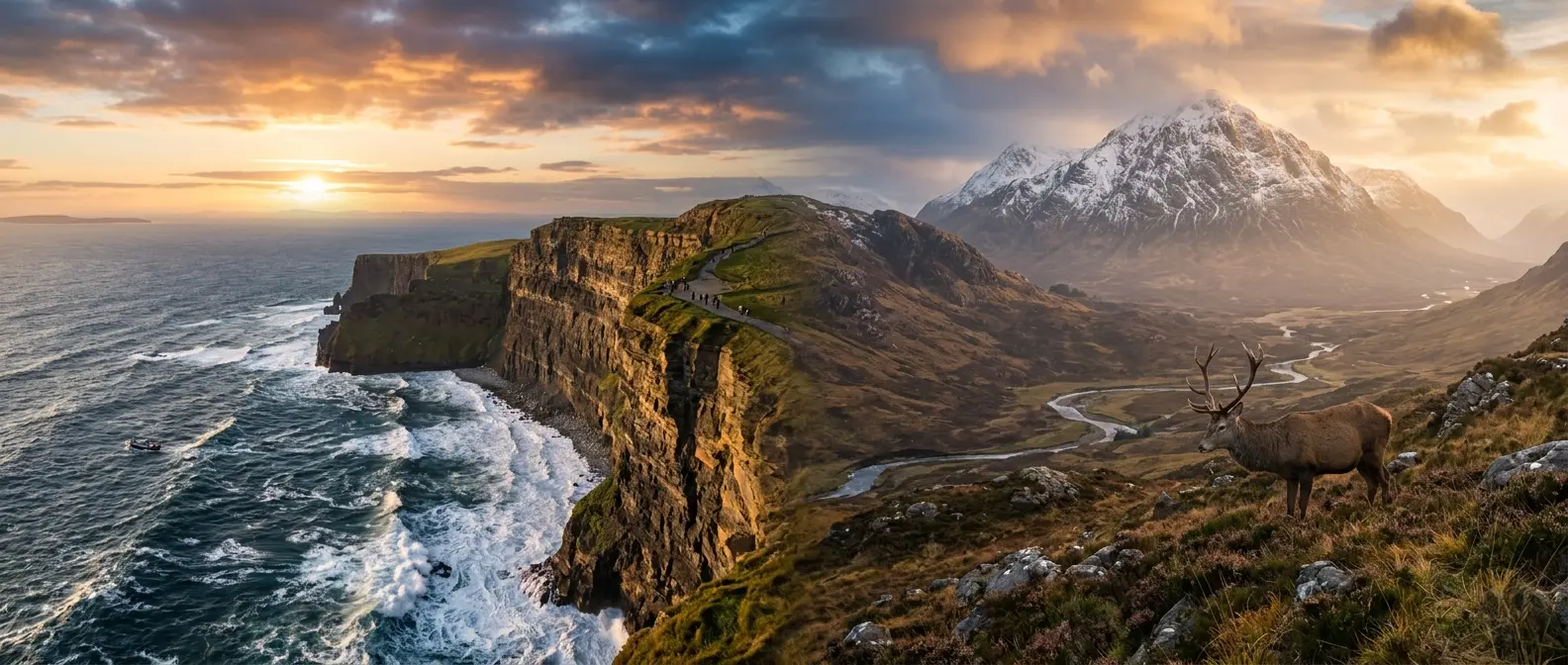
Both are genuinely spectacular but in different ways. Ireland delivers coastal drama — towering Cliffs of Moher, the Wild Atlantic Way winding through fishing villages, and the lunar landscape of Connemara. Scotland overwhelms with scale — Ben Nevis rising above the glens, the misty silence of Glencoe Valley, and the otherworldly rock formations of the Old Man of Storr on the Isle of Skye. First-timers are rarely disappointed by either.
What Is the Best Way to Get from Ireland to Scotland?
You have three solid options:
- Budget flight: Ryanair from Dublin or Knock Airport to Edinburgh costs as little as EUR 17 and takes under an hour. This is the fastest and cheapest option for most travelers.
- Stena Line or P&O ferry: Dublin to Cairnryan takes roughly two hours. The Belfast to Cairnryan ferry is a similar crossing time. Both options let you bring a rental car across, which suits self-drive itineraries.
- Guided tour transfer: If you book an escorted package, transfers between countries are handled for you.
For independent travelers, the Ryanair flight wins on speed and cost. For road trippers who want the freedom to stop wherever they like, the ferry is worth the extra time.
Is a Guided Tour or Self-Drive Better for Ireland and Scotland?
Self-drive suits travelers who want freedom on the Wild Atlantic Way or the North Coast 500 — but you must be comfortable driving on the left. Ireland’s rural roads are narrow; Scotland’s Highland single-track roads require careful passing etiquette. Request an automatic rental car to reduce stress.
Small group guided tours, typically capped at 12 to 16 people, work well for travelers who want a local driver-guide sharing folklore, clan history, and insider knowledge. Private tours offer maximum customization with one dedicated guide throughout. Both options have their place depending on your travel style and experience level.
When Is the Best Time to Visit Ireland and Scotland in 2026?
May and September through October are the sweet spot for most travelers. Here is what each season actually offers:
| Season | Months | Best For | Watch Out For |
| Spring | April to May | Bluebells, wildlife watching, fewer crowds | Unpredictable rain |
| Summer | June to mid-September | Festivals, island-hopping, long daylight | Midges, peak prices |
| Autumn | Late Sept to mid-Nov | Foliage, Bram Stoker Festival, quiet roads | Shorter days |
| Winter | Mid-Nov to March | Hogmanay, northern lights, Burns Night | Cold, limited daylight |
Summer brings the Edinburgh Fringe Festival, the Edinburgh Military Tattoo, the Spirit of Speyside Whisky Festival, and the Islay Festival of Music and Malt. Book accommodation and tickets at least six to nine months ahead for these events — they sell out fast. Winter travelers who visit Edinburgh for Hogmanay get one of the world’s great New Year’s Eve street parties, complete with ceilidh dancing and fireworks above Edinburgh Castle.
What Top Experiences Can You Only Have on These Trips?
Castles
Scotland edges ahead for sheer drama. Edinburgh Castle sits on volcanic rock above the city. Eilean Donan Castle reflects in a Highland loch. Urquhart Castle overlooks Loch Ness. Ireland answers with Rock of Cashel rising from the Tipperary plains, Muckross House set in Killarney National Park, and the ruins of Dunluce Castle perched on a North Antrim cliff.
Film and TV Locations
Scotland is an Outlander and Harry Potter destination like no other. The Glenfinnan Viaduct is where the Hogwarts Express crosses in the films. Edinburgh’s winding alleyways inspired J.K. Rowling’s wizarding world. Perthshire and Doune Castle are essential stops for Outlander fans. The Old Man of Storr on the Isle of Skye features in the 2012 film Prometheus.
In Northern Ireland, Game of Thrones fans will recognize the Dark Hedges as the King’s Road and Dunluce Castle as the inspiration for House Greyjoy’s stronghold. The Aran Islands off Galway served as the setting for the Banshees of Inisherin. The Cliffs of Moher appeared in Harry Potter and the Half-Blood Prince.
Hiking
For Ireland, the Cliffs of Moher clifftop path rewards walkers with views across Galway Bay and toward the Dingle Peninsula. Connemara, Killarney, and Wicklow Mountains National Parks offer trails at every fitness level. In Scotland, Ben Lomond and Ben A’an near Glasgow are accessible beginner hills. The Cairngorms offer ancient Caledonian pine forest walks with red squirrels and red deer alongside the paths.
Food and Whisky
Start both mornings with a full Scottish or full Irish breakfast — eggs, bacon, sausages, black pudding, and either a potato scone or soda bread. Try haggis with neeps and tatties in any traditional Scottish pub. Tour the Guinness Storehouse in Dublin for the full Irish brewing story. End both countries with their signature spirit — Scottish whisky at the Blair Athol Distillery during the Spirit of Speyside Festival, and Irish whiskey at the Old Jameson Distillery in Dublin, which has been distilling since 1780.
Wildlife
Scotland’s Cairngorms hold red deer and red squirrels in Caledonian pine forests. Seabird colonies nest on coastal cliffs from May, and island-hopping tours bring sightings of basking sharks, dolphins, and seals. Ireland’s Wild Atlantic Way offers whale watching and seabird colonies on boat trips from Galway and along the Dingle Peninsula.
What Practical Things Do You Need to Know Before You Go in 2026?
From April 2026, visitors entering the UK — including Scotland and Northern Ireland — need a UK ETA (Electronic Travel Authorisation). The Republic of Ireland is separate and does not require one. If your itinerary combines Dublin, Belfast, and Edinburgh, check your nationality’s requirements before you book flights. This is one of the most overlooked planning steps for combined trips.
Pack layers and a lightweight hooded rain jacket. Wind makes umbrellas useless in both countries. Leave room in the itinerary for spontaneous stops — a Highland cow by the roadside, a sheep crossing on the Ring of Kerry, or a local recommending a pub session happening that night.
Frequently Asked Questions About Trips to Ireland and Scotland
Can you do Ireland and Scotland in 2 weeks?
Yes. Split 14 days as 7 in Scotland covering Edinburgh, Isle of Skye, Glencoe, and the Highlands, and 7 in Ireland covering Dublin, Galway, Ring of Kerry, and the Cliffs of Moher. Travel between countries by Ryanair or ferry mid-trip.
What is the cheapest way to travel between Ireland and Scotland?
A Ryanair budget flight from Dublin or Knock Airport to Edinburgh starts from EUR 17 and takes under one hour. The Stena Line or P&O ferry from Dublin to Cairnryan costs more but allows you to bring a rental car across.
Is driving on the left difficult in Ireland and Scotland?
Most visitors adjust within a day. The trickiest moments are pulling out of junctions and navigating single-track Highland roads in Scotland. Request an automatic rental car. Ireland’s rural roads are narrower than they look on maps, so slow down in villages and keep to the verge when passing.
What wildlife can you see on these trips?
In Scotland, look for red deer in the Cairngorms, puffins nesting on coastal cliffs from May, and basking sharks and seals on island-hopping boat trips. In Ireland, whale watching and seabird colonies are highlights along the Wild Atlantic Way.
Can you see the northern lights in Scotland?
Yes. The aurora borealis is visible in the Scottish Highlands and Orkney, particularly from November through February on clear nights with high solar activity. Head away from light pollution in rural Highlands and check aurora forecast apps before making plans.
What is Hogmanay and is it worth visiting Edinburgh for?
Hogmanay is Scotland’s New Year’s Eve celebration in Edinburgh — one of the world’s largest outdoor New Year parties. It includes torchlit processions, live music, ceilidh dancing, and fireworks above Edinburgh Castle. Book accommodation at least six months ahead.
What is the difference between Scottish whisky and Irish whiskey?
Scottish whisky is typically peated, smoky, and region-specific — Speyside, Islay, and Highland each produce distinct styles. Irish whiskey is triple-distilled, smoother, and lighter. The Old Jameson Distillery in Dublin and the Blair Athol Distillery in Scotland both offer excellent tasting experiences.
What festivals should you plan your trip around?
In Scotland: Edinburgh Fringe Festival (August), Hogmanay (December to January), Highland Games (May to September), Spirit of Speyside Whisky Festival (May), Burns Night (25 January), and Enchanted Forest Pitlochry (October to November). In Ireland: St. Patrick’s Day (17 March), Beltane Festival (May), Galway International Oyster Festival (September), and Bram Stoker Festival (late October Dublin).
Planning Your Trip: The Honest Starting Point
Combining both Celtic nations rewards travelers who plan the logistics early and then stay loose once they arrive. Get the UK ETA sorted, book your accommodation for peak season well ahead, and decide upfront whether self-drive or a guided tour fits your style. Everything else — the castles, the whisky, the wild coastlines, the pub sessions — will take care of itself.
Trips to Ireland and Scotland give you the space to move through both nations without feeling like you are ticking boxes. Start in Edinburgh, end in Dublin, and let the landscape do the rest.
SEO Meta Information
Meta Title: Trips to Ireland and Scotland: Complete 2026 Planning Guide
Meta Description: Trips to Ireland and Scotland in 14 days — discover the best time to visit, how to get between both countries, top castles, hiking trails, whisky experiences, and more.
Additional PAA, Reddit, and Quora Short Answers
One-line direct answers to the most common questions about this topic, structured for AI Overview and AEO performance.
How many days do you need for Ireland and Scotland?
Fourteen days is the minimum recommended — seven days per country covers the key highlights without rushing.
What is the best month to visit Ireland and Scotland?
May is the overall best month — mild weather, fewer midges in Scotland, blooming landscapes, and lower crowds than summer.
Is Ireland or Scotland better to visit?
Both offer different things. Scotland wins for dramatic Highland scenery and whisky; Ireland wins for coastal drives, pub culture, and Celtic mythology.
How do you get from Ireland to Scotland?
Fly with Ryanair from Dublin or Knock Airport to Edinburgh (from EUR 17, under 1 hour) or take the Stena Line or P&O ferry from Dublin or Belfast to Cairnryan in Scotland.
Is a self-drive or guided tour better for Ireland and Scotland?
Self-drive gives freedom on scenic routes like the Wild Atlantic Way and North Coast 500. Guided tours suit travelers who want local expertise and no navigation stress.
What is the best base for exploring Scotland?
Edinburgh is the best base for first-time visitors. Inverness works well for Highlands-focused trips including Loch Ness, Glencoe, and the Isle of Skye.
How much does a trip to Ireland and Scotland cost?
Budget travelers can manage on USD 100 to 150 per day using B&Bs, budget flights, and self-catering. Mid-range trips average USD 200 to 300 per day including hotels and guided experiences.
Is the North Coast 500 worth doing?
Yes. Scotland’s 500-mile scenic coastal driving route through the Highlands is one of the best road trips in Europe. Allow at least three to four days.
What are the best small group tour companies for Ireland and Scotland?
Nordic Visitor, My Ireland Tour, Celtic Tours, and Trafalgar are consistently well-reviewed for combined Ireland and Scotland itineraries.
Which is more scenic, Ireland or Scotland?
Scotland offers bigger mountains and Highland grandeur. Ireland offers wilder coastlines and a softer, greener landscape. Most travelers rate both among the most beautiful places they have visited.
Can you visit Northern Ireland on the same trip?
Yes. Belfast and the Causeway Coastal Route — including the Giant’s Causeway, Dark Hedges, and Dunluce Castle — fit naturally between Dublin and Scotland.
What should I pack for Ireland and Scotland?
Pack waterproof layers, a hooded rain jacket, comfortable walking shoes, and UK plug adaptors. In Scotland, use midge repellent from May through August.
Is it safe to travel solo in Ireland and Scotland?
Both countries rank among the safest travel destinations in Europe. Solo travelers, including women traveling alone, consistently report feeling very safe.
What are the most underrated places in Scotland?
Perthshire, the Trossachs National Park, and the Cairngorms National Park are all stunning and far less crowded than Edinburgh or the Isle of Skye.
What are the most underrated places in Ireland?
The Dingle Peninsula, Kilkenny, Connemara, and County Sligo are genuinely beautiful and much quieter than the Ring of Kerry or Cliffs of Moher.