Love and Trust Messages for Long-Distance Relationships: What to Say in Every Situation
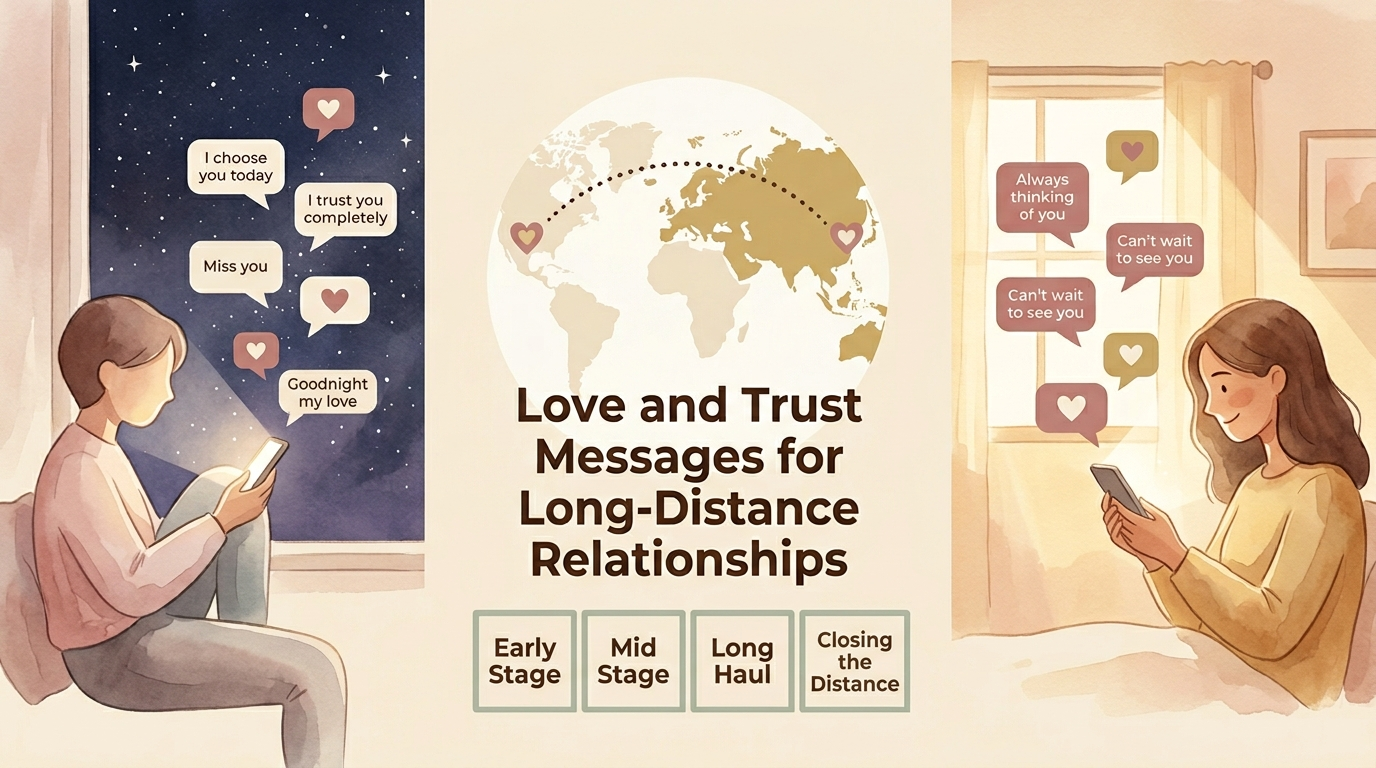
Love and trust messages for long-distance relationships are heartfelt, intentional words that replace physical presence and keep emotional connection alive when miles separate you from your partner. They are not just sweet texts. They are daily proof that your bond is stronger than the distance. The right words at the right moment can change everything.
Distance is hard. You miss their voice. You miss the small moments. You miss the kind of reassurance that only physical touch can give. And sometimes you stare at your phone with nothing to say.
This guide is for that exact feeling. It is not a generic list of copy-paste messages. It covers what to say, when to say it, and why certain words work better depending on your relationship stage and what your partner actually needs right now.
What Are Love and Trust Messages and Why Do They Work Differently in a Long-Distance Relationship?
In a regular relationship, emotional security comes from physical touch, shared experiences, and daily presence. When those things disappear, words carry the full weight.
A love message says: I feel deeply for you. A trust message goes further. It says: you can count on me, I am faithful, and I am choosing you every single day even when you cannot see me doing it.
That distinction matters enormously. Attachment theory confirms that verbal affirmation activates the same emotional safety responses as physical reassurance. Sending love and trust messages for long-distance relationships with real intention is not just meaningful. It is necessary for maintaining the trust bond and keeping your emotional connection strong.
Does the Stage of Your Long-Distance Relationship Change What You Should Say?
Yes. And this is where most people go completely wrong. What lands in month one feels completely different in month fourteen. Here is a simple breakdown:
- Early stage (months 1 to 3): Build anticipation and affirm commitment. Keep messages warm and hopeful. Avoid dwelling on absence.
- Mid-stage (months 4 to 12): Anchor messages in shared memories and consistency. Show faithfulness through specific evidence, not vague promises. Reference your future together with real detail.
- Long-haul stage (12 months and beyond): Honour the patience you have both shown. Acknowledge the emotional longing honestly without making it a burden. A message that says “I see how hard this has been and I am still choosing you” carries more weight here than almost anything else.
- Closing the distance: These are milestone messages. Honour the full weight of the waiting. Celebrate the warm embrace that is finally coming. This moment deserves more than a casual text.
The biggest mistake couples make is sending the same message style across every stage. What reassures a new partner often feels hollow to someone who has been waiting for two years.
What Are the Best Love and Trust Messages for Him in a Long-Distance Relationship?
Men in long-distance relationships need messages that signal genuine respect and loyalty, not just longing. Here are messages that build real emotional security:
- “I trust you completely. Not because I have no choice, but because you have shown me your faithfulness every single day without being asked.”
- “Distance has not made me doubt you once. It has only shown me what kind of man you are when things are hard.”
- “Even from miles away, you are still the steadiest thing in my life. I choose you today and every day.”
These messages do not dwell on absence. They celebrate loyalty and confirm commitment. That combination is what deepens the bond over time.
What Are the Best Love and Trust Messages for Her in a Long-Distance Relationship?
Women in long-distance relationships respond deeply to messages that show emotional attentiveness. She needs to feel seen, not just loved from a distance.
- “I notice how much you carry even when you do not say it. I am proud of you and I want you to feel that from here.”
- “You have never once given me a reason to doubt you. I want you to feel how certain I am about us every single day.”
- “Loving you from afar has only made me more grateful for everything you are. You are worth every mile of this.”
Generic sweet texts do not build emotional security. Comforting notes that speak to her actual reality do. Lead with devotion that is specific enough to feel real.
How Often Should You Send Love and Trust Messages in a Long-Distance Relationship?
The right love and trust messages for long-distance relationships do not need to be long to be powerful. Send them daily.
Short messages with consistency build emotional closeness far better than long messages sent only when inspiration strikes. The pattern of contact matters as much as the content.
A brief daily affirmation says: you are my first thought today. A thoughtful good night message says: you are my last thought too. Together they create a steady structure of presence that bridges the emotional gap every single day.
If you are managing different time zones, schedule your messages to land at emotionally meaningful moments in your partner’s day, not yours. A voice message they wake up to carries real warmth. A text that arrives at 2am while they are asleep does nothing at all.
Does the Format Matter? Text, Voice Message, or Handwritten Letter?
Yes. Each format carries a different emotional weight:
- Text messages: Speed and daily consistency. Best for short reassurance and everyday emotional connection.
- Voice messages: Tone, warmth, and the actual sound of you. Use them for apologies, deeper conversations, or any moment where text strips the meaning completely away.
- Handwritten letters: Lasting shared memories that digital messages simply cannot create. Save them for milestones, reunions, or closing the distance moments.
The best strategy uses all three at different moments. Defaulting to text alone for months creates a flatness that even sincere words struggle to fully overcome.
What Should I Say When My Partner Feels Jealous or Insecure?
Jealousy in a long-distance relationship is not a character flaw. It is an attachment response to physical separation and reduced daily presence. Treating it like an accusation only makes it worse.
Address the silent doubts directly:
“I know distance makes some things feel harder to trust. I want to be clear: I am not going anywhere and I am not interested in anyone else. Your feelings are valid. My commitment to you is not in question.”
Never respond defensively over text. Defensiveness amplifies insecurity rather than resolving it. Lead with empathy first and then anchor your transparency in specific, honest words rather than vague reassurances. The goal is restoring emotional security, not winning the conversation.
What Should I Say When My Partner Is Emotionally Pulling Away?
Emotional withdrawal in a long-distance relationship is often not about love fading. It is usually accumulated emotional loneliness that has not been named out loud yet.
The right message creates a safe space without pressure:
“I can feel something is heavy for you right now. I am not going anywhere. You do not have to be okay today. I am just here.”
Give your partner room to come back on their own timeline. Hope and patience held together are what carry long-distance relationships through the hardest stretches. Do not chase or pressure. Simply hold the door open.
What Should I Say When My Partner Is Having a Mental Health Low?
This is one of the most overlooked situations in long-distance relationships. When your partner is struggling and you cannot be physically present, generic encouragement falls flat and can feel dismissive.
What they need is an anchor, not a pep talk:
“I can hear that things are heavy right now. I am not going anywhere. You do not have to perform being okay for me. I am just here with you.”
Emotional support from a distance looks like presence through words, not solutions through advice. Validate their reality first. Everything else comes after that. When someone feels genuinely heard from miles away, the distance shrinks.
What Should You Never Say to a Long-Distance Partner Over Text?
Some phrases damage the trust bond even when sent without bad intent:
- “Fine, whatever” after an argument signals emotional withdrawal, not resolution.
- “I do not know what you are doing over there” introduces doubt without naming it honestly.
- “You never make time for me” escalates into guilt rather than genuine connection.
- Passive-aggressive one-word replies your partner has to decode from miles away.
- Long silences with no explanation, especially after a disagreement.
Arguing over text without an argument resolution plan is one of the most common damage points in long-distance communication. If a conversation gets heated, pause. Switch to a voice message. Tone changes everything and text strips tone completely.
What Are the Best Messages to Send After an Argument in a Long-Distance Relationship?
Post-argument messages carry extra pressure in long-distance relationships. You cannot use physical touch, eye contact, or simply being in the same room to signal repair. Words have to do all of that work.
Lead with vulnerability rather than justification:
“I know we said things that hurt. I am not interested in being right. I am interested in us. I am sorry for my part in this and I want to fix it.”
“This fight does not change what I feel for you. I am still here and I still choose you. Can we talk when you are ready?”
If trust has been seriously damaged, one message will not fix it. Rebuilding trust requires consistency over weeks. Transparency must increase, not decrease. Small consistent actions backed by sincere words do the real work that grand gestures cannot.
FAQs
Can short messages really maintain trust in a long-distance relationship?
Yes. Short messages sent consistently build emotional presence better than long messages sent sporadically. The pattern matters as much as the content. Brief daily affirmations signal loyalty across miles far more reliably than occasional heartfelt texts that arrive with no follow-up.
What is the difference between a love message and a trust message?
A love message expresses how deeply you feel. A trust message confirms what your partner can rely on. Love speaks to emotion. Trust speaks to security and faithfulness. The strongest love and trust messages for long-distance relationships combine both naturally in the same text.
How do I stop running out of things to say to my long-distance partner?
Routine check-ins become empty when they repeat without variation. Bring in shared memories, specific future plans, and topics from your individual daily lives. Staying emotionally connected requires content that keeps both partners genuinely invested, not just frequent contact with nothing new to offer.
How do I address jealousy in a long-distance relationship without making things worse?
Do not dismiss it and do not over-explain your behaviour. Name the feeling with empathy, confirm your faithfulness with specifics, and avoid responding defensively over text. Emotional security is restored through transparent and consistent communication, not through winning the argument.
How do I make my long-distance partner feel emotionally safe without being physically there?
Through consistency, transparency and sincere words that prove your faithfulness over time. Comforting notes that acknowledge your partner’s actual reality show deeper emotional support than messages focused only on your own feelings. Make them feel your presence despite the physical separation.
The Real Point
Love and trust messages for long-distance relationships are more than words on a screen. They are daily decisions to show up for your partner when the miles make it easy not to. Consistency matters more than perfection. Sincerity matters more than eloquence. Send the imperfect message. Show up every day. The distance is temporary. The bond you build through it is not.