
What Is Internal Conflict? Definition, Types, Examples, and How to Resolve It
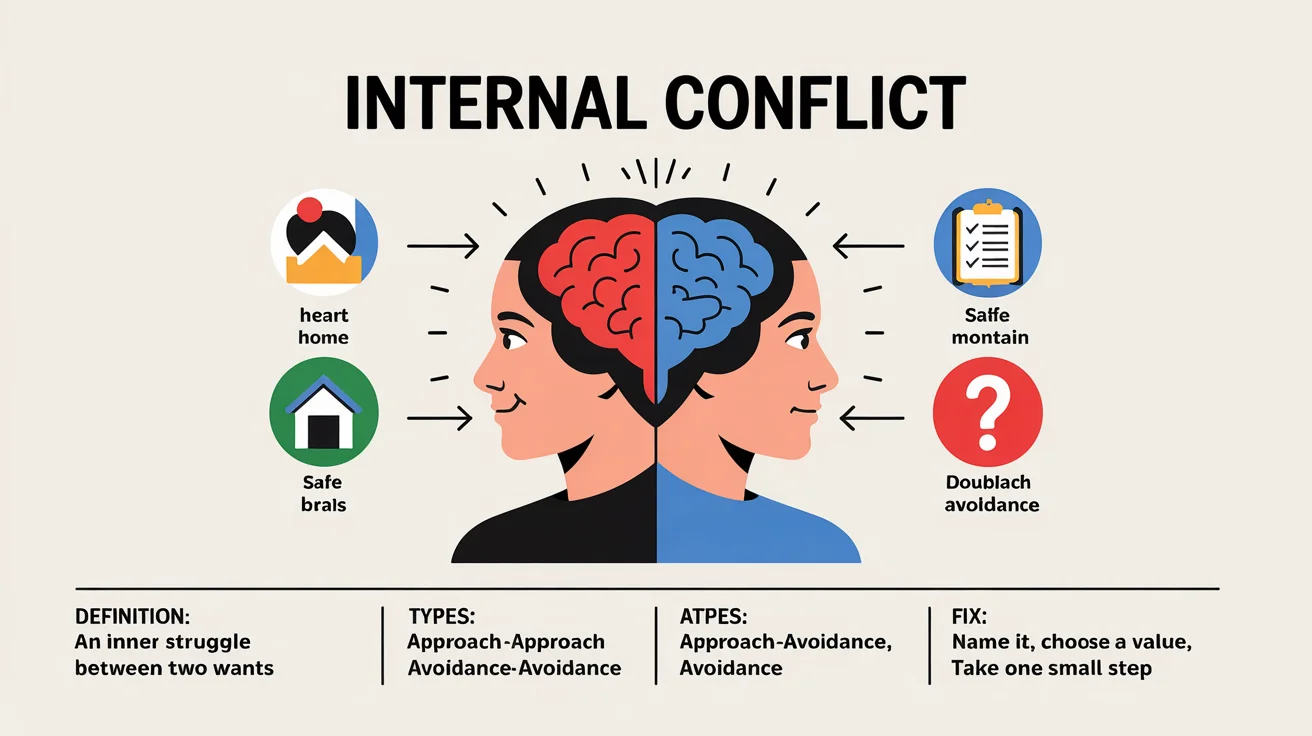
Internal conflict is the struggle inside your mind when two parts of you want different things. One side pushes you forward. The other side pulls you back. It can feel like being stuck, even when the problem seems simple.
Internal conflict meaning
Internal conflict is an inner battle between competing thoughts, emotions, values, or goals.
Internal conflict vs external conflict
Internal conflict happens inside you. External conflict happens between you and something outside, like another person, a rule, or a situation.
The 4 classic types
Psychology often explains internal conflict through four common patterns: approach approach, avoidance avoidance, approach avoidance, and double approach avoidance.
A fast example
You want a better job, but you fear failing in a new role. That push and pull is internal conflict.
What Is Internal Conflict?
Clear definition in plain words
Internal conflict is what you feel when your choices clash inside you. You may want two different outcomes. You may hold two beliefs that do not fit together. You may value safety but crave freedom. This inner struggle can show up as stress, overthinking, and delayed decisions.
Why it feels so intense
Internal conflict drains energy because your brain keeps running the same loop. You replay the options. You imagine regret. You try to protect yourself from risk. When the stakes feel personal, the pressure rises. That is why inner conflict often connects to identity, self worth, and fear of judgment.
Internal conflict vs cognitive dissonance
Cognitive dissonance is the discomfort you feel when your beliefs and actions do not match. Internal conflict is broader. It can include dissonance, but it also includes desire conflicts, value clashes, and fear based hesitation. In real life, they often overlap. You might say one thing matters, but choose something else. That mismatch can create both tension and guilt.
What Causes Internal Conflict?
Competing values and priorities
Many people feel torn because their priorities collide. You may want to support family and also build a career. You may want peace and also want to speak up. These conflicts feel hard because both sides matter. When you do not name the real priority, you stay stuck.
Beliefs vs expectations
Internal conflict often grows when your values collide with outside pressure. Family expectations can pull you one way. Workplace culture can push you another way. Social standards can shape what you think you should do. When your choice becomes about approval, your stress usually climbs.
Fear and self doubt
Fear creates strong inner resistance. You may fear failure. You may fear being judged. You may fear success because it changes your life. Self doubt can make you shrink your goals. It can also create perfectionism, where no choice feels safe enough.
Past experiences and emotional triggers
Old experiences can shape current decisions. A past breakup can make commitment feel risky. A past job loss can make change feel dangerous. Even small memories can trigger shame or guilt. When that happens, your reaction feels bigger than the moment.
The 4 Types of Internal Conflict
Approach approach conflict
This happens when you must choose between two good options. You might pick between two strong job offers. You might pick between two cities you love. The conflict is real because you cannot have both. You may fear choosing wrong, even when both choices work.
Avoidance avoidance conflict
This happens when you face two unpleasant options. You might stay in a job you hate or risk unemployment. You might have a hard talk or keep carrying resentment. This type often creates avoidance and procrastination. People delay because both paths feel bad.
Approach avoidance conflict
This happens when one choice has a clear benefit and a clear drawback. You want the promotion, but you fear burnout. You want to move, but you will miss your support system. This is one of the most common inner struggles in daily life.
Double approach avoidance conflict
This happens when you must choose between two options that both have pros and cons. You want change, but each option carries risk. You want comfort, but each option has a cost. This can feel like mental overload because you keep comparing and re comparing.
Table: Types, feelings, examples, first steps
| Type | What it feels like | Quick example | Best first step |
|---|---|---|---|
| Approach approach | Excited but torn | Two good job offers | Pick your top value and decide |
| Avoidance avoidance | Stuck and drained | Two bad options | Choose the least damaging path |
| Approach avoidance | Pulled forward and back | Promotion with longer hours | Reduce risk with a small test |
| Double approach avoidance | Confused and overwhelmed | Two mixed choices | Write the real tradeoffs clearly |
Signs and Symptoms of Internal Conflict
Mental signs
You may overthink every detail. You may replay the decision in your head. You may struggle to focus. You may feel mental fog and constant second guessing. You may keep searching for the perfect answer.
Emotional signs
Internal conflict can show up as anxiety, irritation, guilt, sadness, or frustration. You may feel on edge. You may swing between hope and dread. You may feel ashamed for not deciding faster.
Behavioral signs
Many people procrastinate when they feel torn. They delay calls. They avoid emails. They scroll instead of acting. Some people people please. Others withdraw. Some get short tempered because the inner stress leaks out.
Physical signs
Your body can react to unresolved stress. You may feel tight shoulders or jaw tension. You may sleep poorly. You may feel fatigue. You may get headaches. Some people feel stomach discomfort during decision pressure.
Mini check: internal conflict or normal uncertainty?
Normal uncertainty fades after you think it through. Internal conflict often repeats. It feels heavy. It keeps coming back. If you keep avoiding the choice, you likely face inner conflict, not simple doubt.
Real Life Examples of Internal Conflict
Career and money
You may want stability and also want purpose. You may want higher pay but fear losing balance. You may want to quit, but feel guilty. In these cases, your conflict often sits between security and growth.
Relationships
You may want closeness and also need space. You may want peace but also need honesty. You may want to stay loyal, but also need self respect. Relationship conflict becomes painful when you fear losing connection.
Self improvement and habits
You may want health goals but crave comfort. You may want better sleep but keep scrolling. You may want to save money but spend to feel better. These conflicts often come from short term relief fighting long term goals.
Morals and ethics
Sometimes you face a values clash. You may feel pressure to follow a rule that feels wrong. You may feel tempted by an easy shortcut. These situations can cause guilt and stress because your identity feels involved.
Internal Conflict in Literature and Storytelling
Man vs self explained simply
In stories, internal conflict is the fight inside a character. It often drives the plot from the inside. Readers connect because they have felt that same tension.
How internal conflict builds character
Writers use inner conflict to show desire, fear, and change. A character wants something, but something inside blocks it. That block can be fear, pride, guilt, or a belief. When the character faces it, growth becomes possible.
External conflict can amplify internal conflict
External pressure often exposes what a character hides. A deadline can reveal fear. A breakup can reveal insecurity. A loss can reveal values. This mix makes stories feel real because life works the same way.
Short popular examples
A character may want power but also wants approval. Another may want love but fears vulnerability. These simple pushes and pulls create tension that feels human.
How to Resolve Internal Conflict
Step 1: Name the conflict clearly
Start with one sentence. Part of me wants this. Part of me wants that. Keep it honest. If you cannot name it, you cannot fix it.
Step 2: Identify what each side is protecting
Every side usually protects something. One side protects safety. Another protects freedom. One protects approval. Another protects peace. When you know what you protect, you stop blaming yourself.
Step 3: Clarify your values and priorities
Ask one question. What matters most in six months. Then ask again for one year. Then ask for five years. This reduces noise. It helps you choose based on direction, not fear.
Step 4: Use a decision tool that fits the conflict
If you feel overloaded, keep it simple. Write the options. Under each option, write the real cost and the real benefit. Add one more line. What will this choice cost me later. That line often reveals the truth.
Step 5: Take one small action to break the loop
Action reduces rumination. You do not need a final answer to begin. You can run a small test. You can talk to one person who has lived it. You can set a deadline for a first move.
Step 6: Set boundaries or adjust commitments
Internal conflict often grows when you carry too much. Reduce the load. Say no to one thing. Rename your priorities. Adjust timelines. Your brain thinks better when your life has space.
When to consider professional support
If this struggle keeps harming sleep, mood, work, or relationships, talk to a therapist or counselor. Support can help you sort fears, beliefs, and patterns faster. It can also help you make decisions with less guilt.
Table: Common problem and what to do
| Common problem | Why it happens | What to do next |
|---|---|---|
| Overthinking | Fear of regret | Set a time limit and decide |
| Avoidance | Anxiety spikes | Choose the smallest step |
| People pleasing | Fear of rejection | Write a boundary script |
| Feeling stuck | Two bad options | Pick the least harmful path |
| Guilt after choosing | Values clash | Recheck your top value |
Common Mistakes People Make and How to Fix Them
Waiting for perfect clarity
Perfect clarity rarely comes. Aim for enough clarity to take the next step. Most good decisions become clear after you start moving.
Choosing only what feels safe
Safety can be wise, but it can also be fear in disguise. Reduce risk instead of avoiding it. Small tests help you learn without burning bridges.
Asking too many people for opinions
Too many voices create more conflict. Choose one or two trusted people. Then decide based on your values, not their anxiety.
Ignoring physical stress signals
Your body often signals overload before your mind admits it. Sleep, food, and movement help you think clearly. Calm your system before big choices.
FAQs About Internal Conflict
What is internal conflict in simple words?
It is feeling torn inside because you want two different things.
What are the 4 types of internal conflict?
Approach approach, avoidance avoidance, approach avoidance, and double approach avoidance.
Is internal conflict the same as cognitive dissonance?
Not always. Dissonance is a belief action mismatch. Internal conflict includes that and more.
What causes internal conflict in relationships?
Competing needs like closeness and independence, plus fear of loss or rejection.
How do you stop overthinking and decide?
Name the two sides, choose your top value, set a deadline, then take one small step.
What is internal conflict in literature?
It is the inner struggle inside a character, often called man vs self.
Can internal conflict be a good thing?
Yes. It can reveal your values. It can guide you toward a better choice.
Conclusion
Internal conflict is normal. It does not mean you are weak. It means something important is at stake. Name the two sides. Find what each side protects. Choose based on your values, then take one small step. That is how you turn inner struggle into forward motion.