
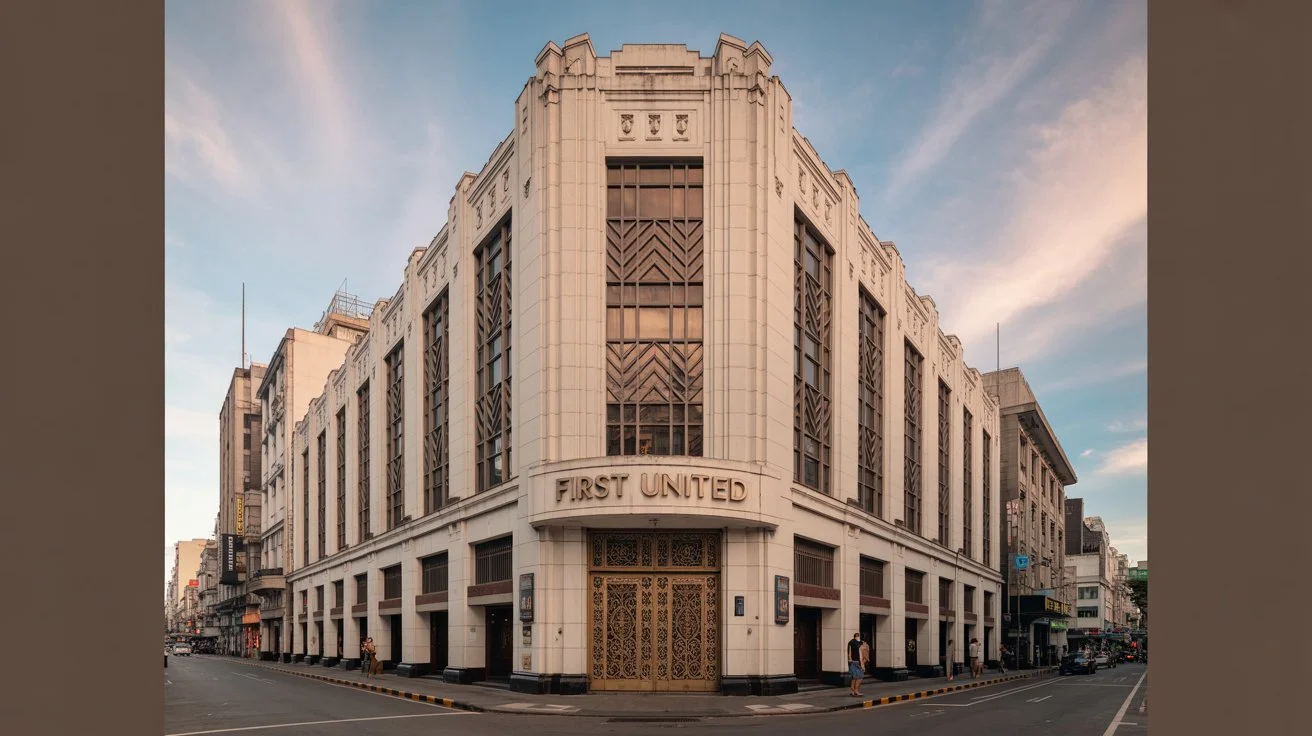
First United Building: Manila’s Art Deco Landmark That Refused to Die
Walk through the wrought-iron doors at 413 Escolta Street, and you’ll step into nearly a century of history. This building has stood since 1928. It survived a world war, decades of neglect, and the slow decline of Manila’s once-grand commercial district.
Andres Luna de San Pedro designed this Art Deco masterpiece. He was the son of famous painter Juan Luna. Back then, they called it the Perez-Samanillo Building. Today, the Sylianteng family owns it. Their choice to preserve rather than demolish sparked Escolta’s creative renaissance.
The Architect’s Vision
Andres Luna studied architecture in Paris during the 1920s. He attended the 1925 International Exposition of Modern Industrial and Decorative Arts. That experience shaped his vision for Manila.
When he returned, the city governor appointed him Chief Architect. He designed the Perez-Samanillo Building with a revolutionary glass facade and one of the Philippines’ first Otis elevators. At six floors, it became Manila’s tallest building.
The Art Deco style shows everywhere. Geometric patterns, boomerang-like chevrons, spirals, and lancet arches cover the exterior. A central tower rises between two chamfered corner towers. The design won first prize in the 1928 House Beautiful Contest.
Don Luis Perez Samanillo, a Spanish businessman, commissioned the building. Sadly, he died during the Spanish Civil War. His son later perished in World War II. Neither saw their building reach its full potential.
Surviving War and Decline
The 1945 Battle of Manila devastated Escolta. The Crystal Arcade, another Andres Luna masterpiece, burned completely. The Perez-Samanillo Building took damage but survived.
After the war, Chinese businessman Sy Lian Teng took over Berg’s Department Store on the ground floor. His family ran it through the 1950s and beyond. Women came from across Manila to shop there. It was the Rustan’s of its era.
But Escolta was changing. Businesses moved to Makati and Greenhills during the 1960s. Berg’s closed in 1981. The golden age ended.
The building found new life through Filipino cinema. Dolphy ran RVQ Productions there from 1974 to 2012. Nora Aunor operated NV Productions from 1973 to 1985. Film companies chose Escolta because theaters on Avenida and Quiapo were nearby.
The Family That Stayed
Most owners sold and left. The Sylianteng family, descendants of Sy Lian Teng, made a different choice in 1979. They could have demolished the building for modern development. Instead, they chose adaptive reuse.
In 2015, they opened the First United Building Community Museum. It honors Sy Lian Teng’s wish to preserve old photographs and archival materials. The museum shows Escolta’s history as Manila’s premier business district.
The Creative Rebirth
Everything changed in 2016. The Syliantengs partnered with One/Zero Design Co to create HUB: Make Lab. Architect Arts Serrano made a brilliant choice. His team stripped old paint off walls, exposing scars from the Battle of Manila. Authenticity beat perfection.
HUB: Make Lab became a creative incubator. Think Chelsea Market but community-focused. Local artists and makers got affordable space.
The Den Coffee & Contemporary Culture serves specialty Philippine coffee. Their grilled cheese sandwiches became locally famous. Fred’s Revolucion, an artist-run bar, stocks local craft beers. Glorious Dias sells vintage finds. Weekend bazaars draw crowds.
The fifth floor houses a 24/7 co-working space with reliable internet.
The Escolta Block Party started in 2016, bringing thousands to the street twice monthly. Carlos Celdran’s #SelfieEscolta campaign spread the word. After pandemic closures, organizers reconceptualized it as Hola Escolta.
Recognition and New Leadership
Robby Sylianteng, the youngest son, now runs the building as managing director. His background in architecture and urban design helps bridge the gap between family and creative community.
In 2024, the building won the Malasakit Gran Prix Award at the Good Design Award Philippines. Jury chair Mylene Abiva explained why it mattered. The building didn’t just preserve history. It created economic activity and drew people seeking authentic experiences over identical malls.
Planning Your Visit
Take the LRT-1 to Carriedo Station and walk to 413 Escolta Street. If driving, park at Escolta Parking Building on 220a Escolta Street.
Entry to the building is free. The museum costs 50 to 100 pesos. The vintage 1920 Otis elevator still works and is worth riding.
HUB Make Lab operates 9am to 6pm. Visit weekends for the most activity. The area feels safest between 10am and 6pm.
Combine your visit with nearby heritage sites. The Regina Building next door is also Art Deco. The Calvo Building has another small museum. You can walk Escolta’s heritage zone in an afternoon.
Questions People Ask
What was it called before?
The Perez-Samanillo Building, named after the original owner.
Is entry free?
Yes. Only the museum charges 50 to 100 pesos.
When is it open?
Hours vary by tenant. HUB Make Lab runs 9am to 6pm. The co-working space operates 24/7.
Who designed it?
Andres Luna de San Pedro, National Artist and son of painter Juan Luna.
Did it survive World War II?
Yes. It was damaged during the 1945 Battle of Manila but remained standing.
Who owns it now?
The Sylianteng family, with Robby Sylianteng as managing director.
Why did celebrities have offices here?
Proximity to Avenida and Quiapo’s movie theaters made it perfect for film production. Dolphy and Nora Aunor both ran studios here.
What should I see inside?
The vintage elevator, museum, Art Deco details, The Den cafe, and HUB Make Lab shops.
Why This Building Matters
Most old buildings in Manila follow a familiar path: decline, neglect, demolition. Something modern replaces what stood before.
This building wrote a different story. A family chose memory over money. Artists chose Escolta over trendy districts. Visitors chose authenticity over air-conditioned malls.
The result proves cities don’t need to erase their past to build their future. Sometimes the oldest structures become the most valuable.
Andres Luna de San Pedro designed a building that won awards in 1928. It won again in 2024. Not for looking new. For staying true.
The wrought-iron doors still open the same way. The elevator still climbs the same shaft. What changed was purpose. Commerce became creativity. Offices became studios. A department store became a coffee shop.
The building adapted without surrendering. Walk down Escolta on a Saturday afternoon. Young people photograph Art Deco details. Freelancers work at cafe tables. Artists sell prints. Couples browse vintage shops.
This is what renaissance looks like. Not reconstruction. Revival.
The building at 413 Escolta Street proves heritage preservation and urban progress aren’t enemies. Done right, they’re partners.