Aga Khan Palace in Pune: History, Architecture and a Quiet Side of the Freedom Struggle
Why Aga Khan Palace Still Matters Today
A calm garden, a big slice of India’s freedom story
Aga Khan Palace looks like a peaceful palace at first view. Green lawns, tall trees and wide corridors make it feel calm. Inside this calm place, some of the hardest days of the freedom struggle unfolded. Mahatma Gandhi, Kasturba Gandhi and Mahadev Desai all spent time here under house arrest after the Quit India call in 1942.
For many visitors it is not just another spot in Pune. It is a place where you can stand close to real events. You see rooms, photos and simple objects that belonged to Gandhi and his close team. The building is also a memorial for Kasturba Gandhi and Mahadev Desai, who died here during that jail period.
Why travellers, students and locals keep coming back
People come for different reasons. Some come to understand history in a real space. Some come for quiet time in the gardens away from traffic. Schools use it as a live classroom to explain the freedom movement to children.
If you like calm places, this palace gives that. If you like stories, it gives that too. This mix of peace and meaning is why many visitors suggest it as a must visit stop in Pune.
Where Aga Khan Palace Sits in Pune and How to Reach It
Exact location and neighbourhood vibe
The palace stands on Nagar Road in the Kalyani Nagar and Yerawada area of Pune. It sits close to busy main roads, yet once you enter, the space feels much quieter. The area around has many homes, offices and cafes. So you can easily mix this stop with food or other errands in the same part of the city.
Distance from station, airport and old city
From Pune railway station, the palace is a short drive of around fifteen to twenty minutes in normal traffic. Pune airport is also close and lies in the same general direction. From the old city and places like Shaniwar Wada, the drive usually takes a bit longer because of traffic and narrow roads.
This makes the palace easy to add to any one day plan in Pune. You can see it after a city tour or on the way to or from the airport.
Best ways to get there
You can reach the palace by cab, auto rickshaw or your own vehicle. City buses run along Nagar Road, so you can get down at a nearby stop and walk the last stretch. Parking is usually available inside or near the gate, which helps families and older visitors.
If you hate hunting for spots or getting lost, simply pin the palace on your map app. The landmark is well known to local drivers, so asking directions also works.
How a Famine Led to the Building of Aga Khan Palace
Who was Sultan Muhammed Shah Aga Khan III
Sultan Muhammed Shah Aga Khan the Third was a spiritual leader of the Nizari Ismaili community. In the late nineteenth century he spent time in India and took an active interest in public life. In 1892 he decided to build this palace near Pune.
The 1892 famine and the palace as an act of charity
The areas around Pune were hit by famine. Many local villagers had lost regular work. To give them paid work, Aga Khan started this building project. Over several years, many workers earned a living by helping to construct the palace. The cost of building ran into many lakh rupees at that time, which shows the scale of the effort.
So this was not only a grand home. It also began as a relief effort during a hard time. That story gives the place a social side that many visitors do not know before they arrive.
From private palace to a landmark for the city
For a long time, the palace was a private property. Over the years it hosted guests and events. During the freedom struggle it took on a very different role as a jail. Later, the Aga Khan family gave the palace to the people of India to honour Gandhi and his work.
Today the Gandhi National Memorial Society manages the complex. It runs as a public memorial, museum and garden that belongs to the country, not to one family.
From Palace Retreat to Gandhi’s Place of Detention
The Quit India Movement and why leaders were brought here
In August 1942, after the Quit India call, the British arrested key leaders. Gandhi, Kasturba Gandhi and Mahadev Desai were moved to this palace and kept under house arrest.
For almost two years, from 1942 to 1944, the building worked as a jail for them. The thick walls and wide rooms now used as galleries were once locked spaces with guards outside. Knowing this changes how you see each corner.
Gandhi, Kasturba and Mahadev Desai’s time inside the palace
Life inside was strict, but not like a normal prison. They were allowed some books, paper and personal things. Gandhi spent his time writing, spinning on the charkha and talking with his close circle. Some letters and items from those days are on display now.
Visitors often feel moved when they see the simple beds and work tables. These small things make the big story of the freedom struggle feel close and real.
The deaths of Kasturba and Mahadev Desai and how they are remembered
Tragedy also touched the group here. Mahadev Desai died in 1942, only days after the arrest. Kasturba Gandhi’s health also failed during the long stay and she passed away in 1944.
Their memorials stand in the garden inside the complex. Later, a portion of Gandhi’s ashes was also placed here and a third samadhi was built. The three white marble structures sit together in a small walled court. People come here to pray, keep flowers and sit in silence for a few minutes.
Architecture and Layout: Arches, Corridors and Green Lawns
First impressions when you walk through the main gate
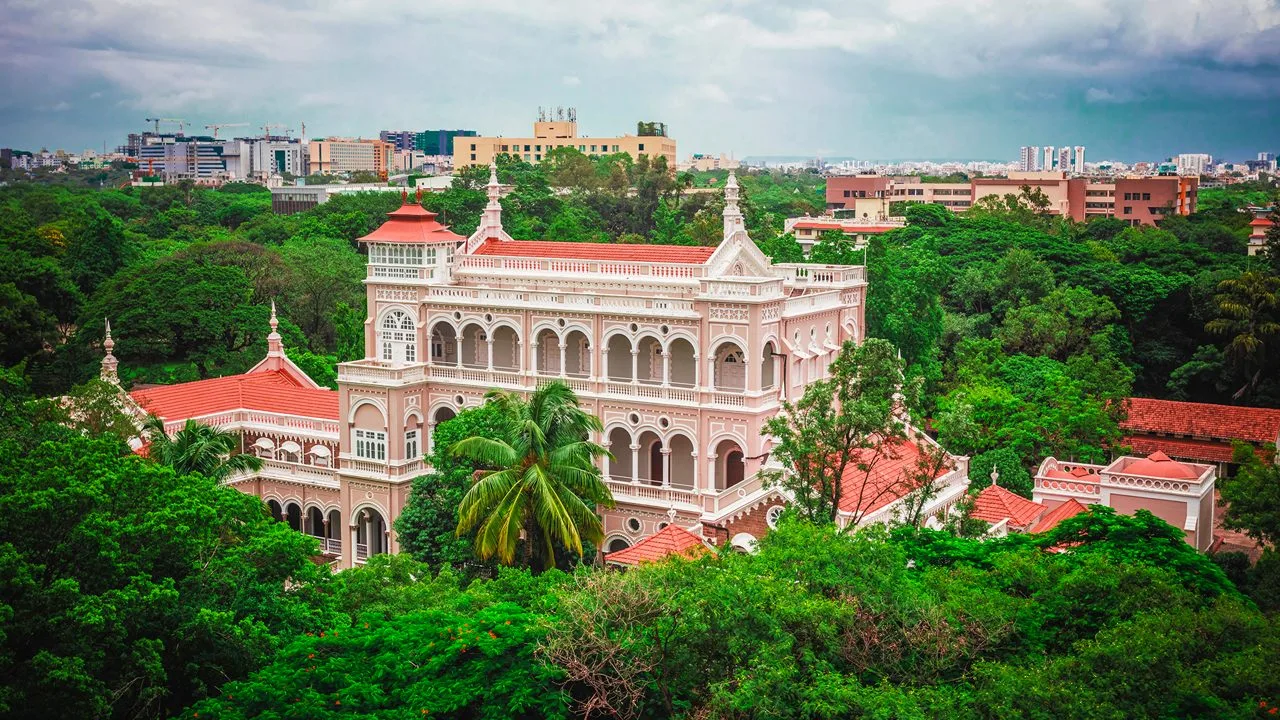
When you step through the gate, the noise of traffic drops. A wide path leads you toward the main building with its cream walls and tall arches. The structure rises above large lawns on all sides.
Most visitors first notice the long front facade and large open space around it. It feels grand but not cold. The simple colour and neat lines give a soft look.
What Indo Saracenic means in simple, visual terms
The style of the building is called Indo Saracenic. This means it blends Indian and European ideas. You see high arches, rounded windows and strong pillars.
Instead of flat walls, there are many small projections and balconies. The roofline has small towers and decorations that add detail without feeling heavy. You do not need to know design terms to enjoy it. You can just look and see how the eye keeps moving along the shapes.
Italian arches, wide corridors and open balconies
The palace has a series of Italian style arches. Many corridors wrap around the building and are about two and a half metres wide.
These covered walks keep you shaded while you move between rooms and halls. Open balconies look out onto lawns and trees. On a normal day, light filters through the arches and makes quiet patterns on the floor. It is a great place for slow walks and simple photos.
Lawns, fountains and the feeling of space
The entire complex covers around nineteen acres. Only part of this is built area. The rest is open ground, trees and gardens.
There are small fountains, simple flower beds and long stretches of grass. You can sit on a bench, watch birds and just rest. For many people, this open space is as important as the museum inside.
Quick Facts About Aga Khan Palace
Snapshot table
| Detail | Info |
|---|---|
| Location | Nagar Road, Kalyani Nagar, Pune, Maharashtra, India |
| Built | 1892 |
| Built by | Sultan Muhammed Shah Aga Khan III |
| Complex size | About 19 acres |
| Style | Indo Saracenic with Italian arches |
| Timings | Usually 9:00 am to 5:30 pm every day |
| Entry fee | Around ₹25 for Indians, higher for foreign visitors, kids often free |
| Managed by | Gandhi National Memorial Society |
| Status | Monument of national importance under national heritage authority |
Who manages the palace today and heritage status
The Gandhi National Memorial Society looks after the building, museum and grounds. The palace is listed as a monument of national importance under the country’s heritage body.
For visitors this means the place is kept open, clean and in working order most of the time. It also means rules of care and respect apply.
Inside the Gandhi Museum: Rooms, Objects and Stories
Simple things Gandhi used that you can still see
Several rooms inside the palace now house the museum. You see spinning wheels, walking sticks, clothes and other daily items linked to Gandhi and his close group.
These objects are simple, but that is exactly why they stand out. They show how basic life was even during huge political work. Many visitors find these small details more powerful than big statues.
Photos, letters and panels that explain the freedom struggle
Walls display photos from different stages of Gandhi’s life. There are charts and panels that explain the events of the Quit India period and the stay in this palace.
If you are new to this part of history, you can learn the basics by slowly reading these boards. If you already know the story, you notice rare pictures and lines from letters. Either way, the museum turns plain dates into something you can picture.
How school groups and first time visitors can move through the galleries
Large groups often get confused about where to start. A simple way is this. First visit the main rooms with photos and objects. Then move to the rooms that show Gandhi’s daily space. After that, step outside to visit the samadhis.
Teachers can ask students to note one object that moved them the most. Families can pick three photos and talk about them on the lawn later. This makes the visit active, not just a quick walk through.
Memorials and Daily Prayer at the Palace
Samadhis of Kasturba Gandhi and Mahadev Desai
The memorial for Kasturba Gandhi and Mahadev Desai sits in a quiet part of the garden. Both structures are made of white marble and share a common court.
There is usually a sense of calm and care around this space. People step in, fold their hands, sometimes sit for a short time and then move out quietly.
Spot where Gandhi’s ashes were placed and key days
A third memorial marks the place where a part of Gandhi’s ashes was placed. On days like Gandhi Jayanti, Martyrs Day, Independence Day and Republic Day, special gatherings and prayers take place here.
If you visit on one of these dates, the grounds can be more crowded. Yet the mood usually stays respectful and calm.
How to behave respectfully in memorial and prayer areas
Many visitors worry about making a mistake here. A few basic habits help. Keep your voice low. Avoid posing for playful photos near the memorial stones. Follow any sign that asks you to remove shoes.
If a prayer is going on, stand to the side and wait till it ends. Small acts like these show that you understand the meaning of the place.
Timings, Tickets and How Long to Spend
Opening and closing hours during the year
Most guides list the opening time as 9 in the morning and closing time as 5:30 in the evening. Some mention a short lunch break around midday.
It is wise to arrive by late morning or mid afternoon. Midday sun can feel harsh in summer, so early or late hours feel better.
Ticket prices and what they cover
The entry fee for Indian adults is low. Foreign visitors pay more, and for children the entry is often free or reduced. The ticket lets you see the grounds, museum and memorials.
Carry small change in cash, as digital options may not always work smoothly at the gate. Keep the ticket with you till you exit, in case any guard checks it inside.
How much time you really need
If you walk very fast, you can see the main points in forty five minutes. But this often feels rushed. A better plan is to keep one and a half to two hours. This gives you time for galleries, the memorial area, some quiet sitting and photos.
Families with small children may move slower, so they should keep extra time. School groups also need more time to handle entries, washroom breaks and questions.
Facilities and Accessibility Inside the Complex
Toilets, water, shade and places to sit
Basic washrooms are available inside the complex. Drinking water is usually present, but carrying your own filled bottle is still a good idea. There are benches and shaded areas near trees and along corridors.
People who tire easily can use these spaces to rest between sections of the visit. Light cotton clothes and a hat help in warmer months.
Parking and entry process
The palace has parking space for cars and two wheelers. You buy the ticket at the gate or just inside, then walk up the main path to the building. Security checks are simple but still present. Avoid bringing bulky bags if you can.
Wheelchair and stroller use
Most ground paths are fairly level, but there are some steps at room entries and inside the main structure. For wheelchairs and strollers, the open grounds are easier than the upper floors. If someone in your group has limited movement, plan to spend more time in the lawns, lower galleries and the memorial space.
Photography, Pre Wedding Shoots and Film Locations
Best times and angles for photos
Morning light and late afternoon light work best. At these times, the front of the palace glows softly and the shadows along the arches look gentle.
Stand back on the main lawn to capture the full facade. Use the side lawns for views that show depth and corridors. Inside, follow any sign about where photos are not allowed.
What is usually allowed with cameras
Casual photography by visitors is usually fine in outdoor areas. For serious shoots with tripods, lights or large crews, you may need permission from the office on site.
Always ask before using drones, as they are often restricted near public buildings. When in doubt, speak to the staff rather than guess.
The palace as a shooting spot
The long arches, lawns and wide steps make the place popular for pre wedding photos. It also appears in films and shows that need a period look.
If you plan such a shoot, contact the office well in advance. Ask about fees, time slots and any rules. This avoids confusion on the day and keeps your team and the staff relaxed.
Putting Aga Khan Palace Into Your Pune Itinerary
Simple half day plan with other nearby spots
If you have only half a day in Pune, one easy plan is this. Visit the palace in the morning, have lunch in Kalyani Nagar or Koregaon Park, then head to the airport or station.
Another option is to see a central city site like Shaniwar Wada first. After that, drive to the palace for a slower end to your day. This mix gives you both busy city life and quiet green space.
One day heritage route that includes the palace
For a full day, you can pair Aga Khan Palace with other old sites. Start at Shaniwar Wada, move to Vishrambag Wada or Lal Mahal, then take a break for food. In the afternoon, come to the palace when the sun is lower.
This route lets you see different sides of Pune history. You move from Maratha forts to Peshwa homes to the freedom struggle, all in one city.
How it compares with other Gandhi sites
Compared with Sabarmati Ashram in Ahmedabad, this place feels more like a palace with gardens than a simple ashram. Compared with Mani Bhavan in Mumbai, it has more open land and fewer city sounds.
Each site adds a different layer to Gandhi’s story. Aga Khan Palace shows hard days of jail life inside a grand building. That contrast makes it special.
Tips to Make Your Visit More Meaningful
Visiting with kids and how to explain the history
Children can get bored if they only hear dates and names. Before you go, tell them a short story about a man who chose simple life and fought without violence. Inside the museum, ask them to find one object they like and share why.
Keep explanations simple. For example, say, “This is where leaders were locked because they asked for freedom.” Short lines like this help young minds understand the mood of the place.
What to read or watch before you go
Reading even one short chapter about the Quit India Movement helps. A simple child friendly biography of Gandhi also sets the stage. Watching a scene from a film that shows his arrest gives added context, since some scenes link to this palace.
This small effort before your visit makes the rooms and photos feel clearer when you see them in person.
Buying khadi and supporting the memorial
Inside the complex you may find a shop that sells khadi and other hand woven cotton goods.
Buying even one small item here does two things. You carry home a useful reminder of the visit. You also support the work that keeps the memorial and craft traditions alive.
FAQs About Aga Khan Palace
1. When was Aga Khan Palace built and who built it?
It was built in 1892 by Sultan Muhammed Shah Aga Khan the Third.
2. Why is Aga Khan Palace important in Indian history?
It is closely linked to the Quit India period. Gandhi, Kasturba Gandhi and Mahadev Desai were kept here under house arrest. Two of them died here, and their memorials stand in the garden.
3. How much time do you need at Aga Khan Palace?
Plan for at least one and a half hours. This gives you time for the museum, the memorials and some quiet sitting on the lawns.
4. Is photography allowed inside and outside?
Simple photography is fine in most outdoor areas. Inside rooms, follow signs and staff instructions. For large shoots or films you must get permission first.
5. Is Aga Khan Palace good for families and kids?
Yes, the gardens and open spaces are good for children. The museum and stories give parents a chance to start simple talks about the freedom struggle. Just watch younger kids near steps and memorial areas.
6. What is the best time of day and season to visit?
Weekday mornings and late afternoons feel most pleasant. October to March usually offers softer weather and clearer skies.