Philippines Landmarks: 7 Must-See Natural Wonders and Historic Sites
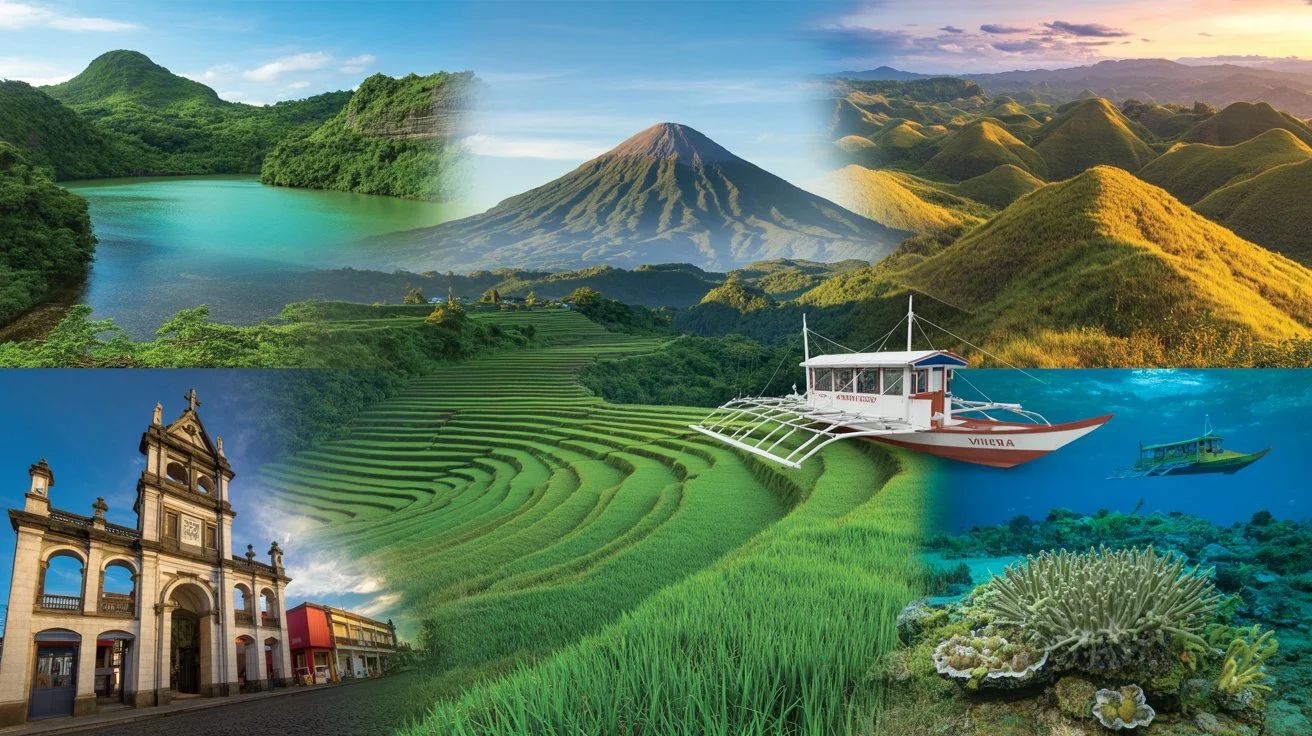
The Philippines has 7,641 islands packed with ancient rice terraces, perfect volcanic cones, and coral reefs that rival anywhere on Earth. Six UNESCO World Heritage Sites call this archipelago home. Spanish churches from the 1500s still stand in Manila. Indigenous tribes maintain 2,000-year-old farming traditions in the mountains.
Most travelers hit the beaches and miss the real treasures. This guide covers seven landmarks that show the Philippines beyond tropical paradise clichés. You’ll learn when to visit, how much to budget, and which transportation actually works.
Banaue Rice Terraces: 2,000-Year Engineering Marvel
The Ifugao people carved these terraces by hand starting around the first century. Stone walls hold millions of cubic meters of soil on mountain slopes. An intricate irrigation system channels spring water down the terraces. UNESCO recognized this in 1995.
The terraces cover 10,360 square kilometers across Ifugao province. Batad offers the most dramatic views with amphitheater-shaped terraces. The one-hour trek from Banaue rewards with stunning photography opportunities.
Getting there: Overnight bus from Manila to Banaue takes 9 hours and costs ₱450-600. From Banaue town, jeepney to Batad trailhead takes 1 hour, then 30-minute hike.
Costs: Environmental fee ₱200, local guide ₱500-800 per day, homestay ₱300-500 per night
Best season: March to May for clear mountain views. Avoid July through September when typhoons bring heavy rain.
Problems solved: Altitude causes shortness of breath—take breaks during hikes. Trails get muddy after rain—bring boots with tread. No ATMs in villages—carry enough cash from Banaue town.
El Nido: Limestone Karst Paradise
Forty-five islands surround El Nido town on Palawan’s northern tip. Limestone cliffs rise vertically from turquoise water. Hidden lagoons require kayaking through narrow passages. Four standard island tours cover different areas.
Big Lagoon and Small Lagoon offer kayaking through towering karst walls. Shimizu Island provides excellent snorkeling on coral reefs. Nacpan Beach stretches four kilometers with perfect sunset views.
Getting there: Fly Manila to Puerto Princesa (1.5 hours, ₱2,000-4,000), then van to El Nido (5-6 hours, ₱600-800).
Costs: Island tours ₱1,200-1,500 per person, environmental fee ₱200, accommodation ₱800-20,000
Best season: November through May. Peak season December to March brings crowds.
Problems solved: Tours pack boats with 20-30 people—private charters cost ₱6,000-8,000 but worth it. December through February books solid—reserve accommodations three months ahead.
Chocolate Hills: Bohol’s 1,268 Mysterious Mounds
Over 1,200 cone-shaped hills cover 50 square kilometers. Grass turns chocolate-brown from February through May. Scientists suggest uplifted coral deposits shaped by erosion. The Philippine government declared them a National Geological Monument.
Chocolate Hills Complex viewing deck provides the classic vista. You climb 214 steps to the platform. Early morning light creates dramatic shadows on the hills.
Getting there: Fly from Manila or Cebu to Tagbilaran. Van or car to Carmen takes 1.5 hours covering 55 kilometers.
Costs: Viewing platform ₱50, full-day van tour ₱2,500-3,500
Best season: February to May shows chocolate-brown color.
Intramuros: Manila’s Walled Colonial City
The Spanish built this citadel starting in 1571 to defend Manila. Stone walls stretch 4.5 kilometers with seven gates. Fort Santiago defended the river entrance—now a park honoring national hero José Rizal.
San Agustin Church dates to 1607. Baroque architecture adapted to earthquake risks with thick walls. UNESCO recognized it in 1993. Casa Manila recreates a Spanish colonial home showing how wealthy families lived.
Getting there: LRT-1 to Central Terminal Station, then 5-minute walk. Grab or taxi from Manila hotels.
Costs: Fort Santiago ₱75, San Agustin Church ₱200, Casa Manila ₱75
Best season: November to April for comfortable weather.
Mount Mayon: The World’s Most Perfect Cone
Mayon Volcano rises 2,462 meters with near-perfect symmetry. Volcanologists call it the most geometrically regular cone globally. Eruptions in 1993 and 2018 caused deaths and evacuations.
Cagsawa Ruins provides the classic viewing spot. A church stood here until Mayon’s 1814 eruption buried the town. Only the bell tower remains. Visit between 8 and 11 AM before clouds obscure the peak.
Getting there: Fly Manila to Legazpi (1 hour) or take bus (10 hours overnight). Cagsawa Ruins sits 15 kilometers away, 30 minutes by tricycle.
Costs: Cagsawa entrance ₱30, ATV tour ₱1,500-2,500
Best season: November through May for clear visibility.
Coron: Wreck Diving and Lake Adventures
Twelve Japanese ships sank in Coron Bay during the 1944 Battle of the Philippines. They now serve as artificial reefs. Okikawa Maru oil tanker sits at 26 meters depth—suitable for intermediate divers.
Kayangan Lake claims the title of Philippines’ clearest water. A 10-minute hike reaches the viewpoint, then stairs descend to the lake. Swimming in the cool fresh water surrounded by limestone cliffs creates magical moments.
Getting there: Fly Manila to Busuanga (1 hour, ₱2,500-5,000).
Costs: Wreck diving ₱2,500-3,500 for two-tank dives, lake tours ₱1,800-2,200
Best season: November to May for calm seas.
Vigan: Best Preserved Spanish Town
Calle Crisologo features ancestral houses with tile roofs and capiz shell windows. Horse-drawn carriages clatter on cobblestones. The entire town earned UNESCO status in 1999.
Syquia Mansion Museum displays period furniture and personal items. Pottery factories show traditional methods—you can watch artisans work. Vigan Cathedral combines European and Filipino styles.
Getting there: Direct bus from Manila (9-10 hours, ₱700-900).
Costs: Museum entrances ₱30-60 each, kalesa rides ₱600-800 per hour
Best season: November through April for dry weather.
When to Visit Philippines Landmarks
The Philippines has two seasons—dry (November-May) and wet (June-October). Typhoons hit July through September.
Peak Season (December-March): Perfect weather but prices increase 40-60 percent. Book accommodations two months ahead.
Shoulder Season (November, April-May): Good weather with prices 20-30 percent lower. Fewer tourists improve experiences.
Wet Season (June-October): Prices fall 40-50 percent but heavy rain and typhoons risk cancellations.
Budget Planning
Budget Traveler: ₱1,500-2,500 daily (hostels, street food, public transport)
Mid-Range Traveler: ₱4,000-7,000 daily (comfortable hotels, mix of restaurants, tours)
Luxury Traveler: ₱15,000+ daily (resorts, fine dining, private transfers)
Money-saving strategies: Travel shoulder season for 30 percent lower costs. Take overnight buses to save hotel nights. Eat at carinderias where meals cost ₱50-100. Join group tours instead of private charters.
Essential Travel Tips
Transportation: Philippine Airlines, Cebu Pacific, and Air Asia serve major routes. Book early morning flights—less likely to delay. 2GO Travel operates ferries between islands.
Money: Bring mix of cash and cards. ATMs exist in cities but scarce in remote areas. Use GCash mobile payments for better rates.
Safety: Use Grab instead of random taxis. Stick to bottled water. Wear helmets on motorbikes. Check PHIVOLCS alerts before visiting active volcanoes.
Cultural respect: Dress modestly at churches—cover shoulders and knees. Remove shoes when entering homes. Ask permission before photographing people.
Answers to Common Questions
Do I need a visa? Most nationalities get 30-day visa-free entry including USA, EU, UK, Canada, Australia. Requirements include passport valid six months, return ticket, and accommodation proof.
Is tap water safe? No. Drink bottled water only. Use it for brushing teeth too.
What language is spoken? Filipino and English are official languages. Most Filipinos speak English well. Signs and menus use English.
When is the best time? November through May for dry weather. December-March sees peak crowds. November and May offer best value.
How safe is it for solo travelers? Generally safe with normal precautions. Filipinos show famous hospitality. Use ride-sharing apps. Avoid isolated areas after dark.
Making the Most of Your Trip
Start with three to five landmarks based on your time. Beach lovers should focus on El Nido and Coron. History enthusiasts need Manila and Vigan. Hikers belong in Banaue.
Book flights and popular accommodations ahead. Stay flexible with daily plans. Pack light—laundry services work everywhere. Bring cash for remote areas. Download offline maps before traveling.
The Philippines rewards adventurous spirits. Infrastructure lags in places. Plans go sideways sometimes. These challenges add authenticity. Those wanting genuine adventures find the Philippines perfect.